

DePaul University Athletics
Hay Challenge Provides Hope for Those in Need
10/13/2020 2:04:00 PM | ATHLETICS
Donors' selfless generosity sustains first-generation and low-income college students
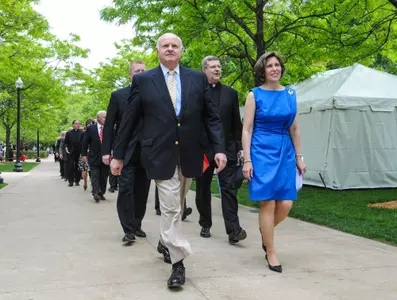
CHICAGO – In some ways, DePaul Vice-President of Advancement Dan Allen, Dave Faircloth, Ed Leidecker and Marge Mazik are the living embodiment of the legacy created by one of the university's most cherished benefactors, the late Bill Hay.
Hay is the DePaul MBA alumnus who made such a profound impact on everyone throughout the university community whether as a Board of Trustee member or instructor in the business school and the School of Public Service.
Few have ever loved DePaul more or believed as passionately in its mission as Hay, whose significant eight-figure gift from his estate established the William E. Hay Center for Leadership Development empowering students with the leadership training that Fortune 500 companies offer their top talent.
His sensitivity to the needs and daunting challenges faced by first-generation and low-income college students resulted in the Hay Endowed Scholarship Challenge.
In essence, it allows donors to make a $25,000 gift to create a named endowment with the Challenge providing an additional $25,000 to reach the permanent endowment level.
"The significance of the Hay Challenge cannot be understated," Allen said of Hay, who passed away in 2018. "It is a transformative gift, and its impact will be felt for decades to come.
"But that was Bill. He wanted to encourage others to step up. He was always thinking about how we could leverage challenges and funds to encourage current donor engagement and inspire a new crop of donors. He was very forward-thinking and completely embodied the DePaul mission in his giving history.
"Bill loved DePaul and cared deeply for its Vincentian mission, its students and the Driehaus College of Business. Bill had high expectations and standards, wanting only the very best for DePaul and its students.
"He also loved his fellow DePaul trustees and left an indelible impression upon them. I'm still humbled that even today, so many of his fellow trustees who served with him say: 'Oh, I loved Bill and really miss him and his presence at our board meetings' whenever his name is brought up in conversation."
Allen learned at an early age some of the most important lessons of his life growing up in what he described as "decidedly blue-collar, no-nonsense" Joliet, a place that demanded respect for everyone where the children of lawyers, physicians and bank presidents went to school with the children of first responders, union trades workers, teachers and nurses.
"It was just that kind of place," Allen said. "If you didn't learn how to respect every person around you and understand that you were no better or worse, you would learn that eventually---perhaps in an unflattering way. As a result, having an understanding of and empathy for the plight of those who didn't have the same as you was simply a part of growing up in my family and in Joliet."
Such an upbringing inspired Allen to put his unwavering convictions into everyday life.
"I believe helping low-income, disadvantaged, academically qualified students and first-generation students is one of the most pressing public policy issues of our time," he said. "We must be committed as a nation to investing in our fellow citizens and ensuring that each has the opportunity to pursue a postsecondary education without regard to their ascribed characteristics---and without regard to family income.
"How can we NOT invest in the future talent of our nation? I truly believe that if you change one life with a scholarship and a college degree, you can change a family. And if you change a family, you can change a block or a school or a congregation, and then you change a neighborhood. Eventually you can change a city and everything follows after that. This may not be realized in a lifetime, but making this investment has that effect. I really believe that."
His roots to DePaul run deep, beginning with his dad of the same name who worked as a manager for legendary basketball coach Ray Meyer and graduated in 1961.
"My dad was a great person and I miss him every single day," Allen said. "DePaul meant everything to him. Really, it did, and he so loved the university and especially Coach.
"My dad was one of those kids I described above whose life was transformed by DePaul. He was the son of a railway worker, and I never remember my grandmother working outside the home. His DePaul education allowed him to raise and provide for his family in such a way that each of his children have college and graduate educations that have allowed us to pursue lives that were probably unimaginable to him and my mom---changing our lives for generations to come. That happened because of DePaul.
"I also remember evenings at the dinner table if DePaul lost a basketball game to Notre Dame when we ate in silence as a family. Truly, it meant that much to him! He passed away 20 years ago this past August, and I can still recall Coach Ray attending his wake. Coach walked into a very crowded and noisy funeral home with many people reminiscing---and the room fell silent. It was an amazing gesture of support to my mom and our family and really spoke to the importance of family at DePaul."
As Allen reminisced, so many of the parallels between his father and the school he loved became so apparent---as well as the life lessons handed down from father to son.
"My dad had a tireless work ethic," Allen said. "As kids, we were always expected to show up, work hard, get our hands dirty and give our best. If he was ever unhappy with us as kids, it was because he thought we didn't give an honest effort.
"That is so DePaul. Gritty perseverance, never quitting, 'getting after it,' as we used to say---that was my dad, and that is also part of DePaul's DNA. He worked in public school education, and during the summers he would paint houses with our next-door neighbor---literally climbing rickety old wooden ladders with missing rungs to paint the second stories of frame homes. He used a large wooden paddle to stir the five-gallon paint buckets. I keep that paddle in my office as a reminder of the importance of hard work and never being above it all."
As if that isn't enough of a reminder, Allen shared this memorable anecdote.
"I recall being at mass with him in high school and as a typical teenager, not very joyfully participating in the singing of hymns," Allen said. "My dad leaned over and whispered into my ear; 'I imagine you think you are too cool to sing.'"
*****
In some ways, Dave Faircloth is cut from the same fabric. The 1988 College of Commerce alum and Northern Trust Corporation senior investment officer has established the David and Beth Faircloth Endowed Scholarship to help those who are confronted with some of the same challenges he overcame.
"Attending DePaul was a transformative event in my life," Faircloth said. "My mother was a high school graduate and my father was a high school dropout.
"My father left us after sixth grade and I started working at my first job before my freshman year of high school. I've been continuously employed since the end of my sophomore year of high school, usually working two or three full and part-time jobs while in high school and college. The ability to afford and complete college was never a certainty.
"After earning my Associates degree, I transferred to DePaul for my last two years. Historically, DePaul has served first generation and low-income students. I was basically DePaul's 'target market.' Those were two of the many reasons I chose to attend DePaul."
And after that DePaul experience pointed him in the right direction while ascending higher and higher in the world of finance, this first-generation graduate never forgot how he reached the top.
"DePaul was and remains an important part of my life," Faircloth said. "The university helped me with grants, loans and a job on campus so that I could afford to earn my Bachelor's degree.
"I wanted to give something back to DePaul and future generations. As the son of a single mother, I've asked DePaul to award the David and Beth Faircloth Endowed Scholarship to student-athletes and managers who come from single-parent families."
Success stories like Faircloth are the lifeblood of the university, blazing a trail for others in a similar predicament and providing the resources to reach their destination.
That's what Bill Hay was all about, generating scholarships and providing students the financial support to pursue their dreams of a DePaul education while easing the burden of balancing rigorous class schedules and much-needed jobs that help finance their education.
Hay earned his MBA from DePaul in 1966 and an honorary Doctor of Humane Letters in 2006. He founded William E. Hay & Co., a Chicago-based consulting and executive search firm.
Faircloth has been cheering on the men's and women's basketball teams as a season ticketholder since 2003. He still remembers being challenged and interested in classes for the first time in his life, assuming leadership positions in student organizations like Beta Gamma Sigma and the Financial Management Association and attending games at the Rosemont Horizon.
"The Horizon wasn't a very good facility, but DePaul was Chicago's team in the 1980s, and the Blue Demons were exciting to watch," Faircloth said. "I've been fortunate enough to attend hundreds of sporting events in my life, including a MLB All-Star Game and all four games of the White Sox's 2005 World Series.
"But the best game I've ever been to was a DePaul double-overtime victory over Notre Dame at the Horizon."
*****
Ed Leidecker could not have picked a better time to attend DePaul---at least when it comes to college basketball.
The 1980 graduate with a degree in Finance was on campus having the time of his when Mark Aguirre & Co. made that memorable run to the Final Four while captivating Chicago's sports audience and becoming the darlings of the city when the Windy City's pro teams were struggling.
Back then, it was all DePaul all of the time behind Aguirre, Thornton's very own Curtis Watkins, Gary Garland and Clyde Bradshaw with James Mitchem the man in the middle. The Blue Demons upset top-seeded UCLA to reach the 1979 NCAA Semifinals where they came up short against Indiana State and All-American Larry Bird.
"While I was attending DePaul as an undergraduate student, the men's basketball team kept getting better each year and made the Final Four in my junior year," Leidecker said. "Ironically, I was on a DePaul University Ski Club trip to Colorado and watched the game on TV against UCLA to send the team to the Final Four.
"The condo property manager where we were staying threatened to call the police on us for being too loud and it was a Saturday afternoon."
Leidecker has been a men's basketball season ticketholder for 39 consecutive years dating back to the 1981 season.
He has established the Ed Leidecker Endowed Scholarship for student-athletes studying business from either the men's or women's basketball teams or the softball team.
"I started the endowed scholarship to assist students-athletes enrolled in the Driehaus School of Business," Leidecker said. "Most athletes will need to rely on a working career other than professional sports to support themselves and their families.
"The Driehaus School of Business laid the groundwork for me to have a 36-plus year career at my current employer in the defense industry.
"I have been blessed and decided to share with the university while I am still walking this earth and able to see the impact of an endowed scholarship."
When he graduated, Leidecker was 16 hours (four classes short) of an Accounting degree. He commuted 1.5 hours each way daily to the Downtown campus while working more than 30 hours a week after school and weekends while an undergraduate.
The day he completed his last exam for the Finance degree, he registered for two of the four remaining Accounting classes in the fall quarter. He finished the last two Accounting classes in the winter quarter of 1981. Leidecker earned his MBA in Finance in 1986 finishing in 2.5 years while working full-time.
"The late Mr. Hay was a very generous man," Leidecker said. "His generosity inspired me to establish an endowed scholarship. The Hay Challenge will greatly help to expand the DePaul reach to first-generation college and low-income students.
"I'll always remember faculty that really enjoyed teaching and helping students if they sought additional help or guidance. There were several great DePaul basketball teams, and I enjoyed seeing great opposing teams and coaches. I won't forget a packed Rosemont Horizon and games that rocked the arena."
*****
For Marge Mazik, DePaul truly is a family affair. The former Athletics Development staffer graduated from DePaul and worked there for 20 years, earning the Via Sapientiae Award in 2014---the highest honor the university can bestow upon a member of its community.
Her husband Hank graduated in 1968 with a degree in Accounting. Daughter Christine Mazik graduated with a degree in Nursing in 1994 and was a manager for the women's basketball team while son Jim Mazik graduated with a degree in Computer Science.
Marge's children Chris, Jim, Steve and Mary, Marge's parents along with her brother Matt and all the grandchildren always attended DePaul games, activities and events.
"Sports events were a great opportunity to meet and greet so many who share in DePaul's history, and it is wonderful to see their children and grandchildren---some of whom have also attended DePaul," Marge Mazik said. "Athletic events have always been enjoyed by our family. Our children used to think Ray Meyer was a relative we saw him so often. Our kids were born DePaul fans.
"I worked with the most wonderful people at DePaul. Jean Lenti Ponsetto and Doug Bruno will always have a special place in our family's heart. It was also truly a pleasure working alongside Thad Dohrn for many years in Athletics Development. We will always cherish our memories and experiences and look forward to creating many more."
It's a no-brainer that Marge and Hank quickly embraced the Hay Challenge, establishing the Matthew F. Wojtaszek, Jr. Scholarship for men's basketball and the Mazik-Wojtaszek Scholarship for women's basketball.
"Our family has always believed creating a scholarship would be a wonderful way to give back to the community and provide students the opportunity of receiving a great education at DePaul," Mazik said. "Through the generosity of the William Hay Challenge, we felt this would be an ideal time to take advantage of creating two scholarships.
"My brother Matt recently passed away, and we felt what better way to honor him than to create a scholarship in his name. He attended DePaul and was a loyal supporter of DePaul Athletics for many years.
"The Hay Challenge is truly a significant opportunity for DePaul to reach out to first-generation and low-income college students. There are so many gifted, intelligent people who just need a chance to reach their full potential. Through William E. Hay's generosity, they can get this chance."
The legacy of Bill Hay lives on in the actions of Allen, Faircloth, Leidecker and Mazik. His friends and colleagues remember him as a trusted advisor, an aficionado of organization design, an incredible communicator, a frustrated golfer, a man of detail, having an infectious laugh and for his great insight and generosity with board work and charitable endeavors.
Allen is both proud and thankful of the way DePaul's donor community has come through time and time again.
"I cannot truly express the depth of my gratitude for all our donors, of the Hay Challenge and beyond---especially at this time in our society when student need is greater than ever before," Allen said.
"What is truly inspiring is how the gifts our alumni, parents, friends, corporations, foundations, faculty and staff share with the university are often designated for the benefit of people they don't even know!
"Think about that. Isn't that the very definition of selflessness?"
Hay is the DePaul MBA alumnus who made such a profound impact on everyone throughout the university community whether as a Board of Trustee member or instructor in the business school and the School of Public Service.
Few have ever loved DePaul more or believed as passionately in its mission as Hay, whose significant eight-figure gift from his estate established the William E. Hay Center for Leadership Development empowering students with the leadership training that Fortune 500 companies offer their top talent.
His sensitivity to the needs and daunting challenges faced by first-generation and low-income college students resulted in the Hay Endowed Scholarship Challenge.
In essence, it allows donors to make a $25,000 gift to create a named endowment with the Challenge providing an additional $25,000 to reach the permanent endowment level.
"The significance of the Hay Challenge cannot be understated," Allen said of Hay, who passed away in 2018. "It is a transformative gift, and its impact will be felt for decades to come.
"But that was Bill. He wanted to encourage others to step up. He was always thinking about how we could leverage challenges and funds to encourage current donor engagement and inspire a new crop of donors. He was very forward-thinking and completely embodied the DePaul mission in his giving history.
"Bill loved DePaul and cared deeply for its Vincentian mission, its students and the Driehaus College of Business. Bill had high expectations and standards, wanting only the very best for DePaul and its students.
"He also loved his fellow DePaul trustees and left an indelible impression upon them. I'm still humbled that even today, so many of his fellow trustees who served with him say: 'Oh, I loved Bill and really miss him and his presence at our board meetings' whenever his name is brought up in conversation."
Allen learned at an early age some of the most important lessons of his life growing up in what he described as "decidedly blue-collar, no-nonsense" Joliet, a place that demanded respect for everyone where the children of lawyers, physicians and bank presidents went to school with the children of first responders, union trades workers, teachers and nurses.
"It was just that kind of place," Allen said. "If you didn't learn how to respect every person around you and understand that you were no better or worse, you would learn that eventually---perhaps in an unflattering way. As a result, having an understanding of and empathy for the plight of those who didn't have the same as you was simply a part of growing up in my family and in Joliet."
Such an upbringing inspired Allen to put his unwavering convictions into everyday life.
"I believe helping low-income, disadvantaged, academically qualified students and first-generation students is one of the most pressing public policy issues of our time," he said. "We must be committed as a nation to investing in our fellow citizens and ensuring that each has the opportunity to pursue a postsecondary education without regard to their ascribed characteristics---and without regard to family income.
"How can we NOT invest in the future talent of our nation? I truly believe that if you change one life with a scholarship and a college degree, you can change a family. And if you change a family, you can change a block or a school or a congregation, and then you change a neighborhood. Eventually you can change a city and everything follows after that. This may not be realized in a lifetime, but making this investment has that effect. I really believe that."
His roots to DePaul run deep, beginning with his dad of the same name who worked as a manager for legendary basketball coach Ray Meyer and graduated in 1961.
"My dad was a great person and I miss him every single day," Allen said. "DePaul meant everything to him. Really, it did, and he so loved the university and especially Coach.
"My dad was one of those kids I described above whose life was transformed by DePaul. He was the son of a railway worker, and I never remember my grandmother working outside the home. His DePaul education allowed him to raise and provide for his family in such a way that each of his children have college and graduate educations that have allowed us to pursue lives that were probably unimaginable to him and my mom---changing our lives for generations to come. That happened because of DePaul.
"I also remember evenings at the dinner table if DePaul lost a basketball game to Notre Dame when we ate in silence as a family. Truly, it meant that much to him! He passed away 20 years ago this past August, and I can still recall Coach Ray attending his wake. Coach walked into a very crowded and noisy funeral home with many people reminiscing---and the room fell silent. It was an amazing gesture of support to my mom and our family and really spoke to the importance of family at DePaul."
As Allen reminisced, so many of the parallels between his father and the school he loved became so apparent---as well as the life lessons handed down from father to son.
"My dad had a tireless work ethic," Allen said. "As kids, we were always expected to show up, work hard, get our hands dirty and give our best. If he was ever unhappy with us as kids, it was because he thought we didn't give an honest effort.
"That is so DePaul. Gritty perseverance, never quitting, 'getting after it,' as we used to say---that was my dad, and that is also part of DePaul's DNA. He worked in public school education, and during the summers he would paint houses with our next-door neighbor---literally climbing rickety old wooden ladders with missing rungs to paint the second stories of frame homes. He used a large wooden paddle to stir the five-gallon paint buckets. I keep that paddle in my office as a reminder of the importance of hard work and never being above it all."
As if that isn't enough of a reminder, Allen shared this memorable anecdote.
"I recall being at mass with him in high school and as a typical teenager, not very joyfully participating in the singing of hymns," Allen said. "My dad leaned over and whispered into my ear; 'I imagine you think you are too cool to sing.'"
*****
In some ways, Dave Faircloth is cut from the same fabric. The 1988 College of Commerce alum and Northern Trust Corporation senior investment officer has established the David and Beth Faircloth Endowed Scholarship to help those who are confronted with some of the same challenges he overcame.
"Attending DePaul was a transformative event in my life," Faircloth said. "My mother was a high school graduate and my father was a high school dropout.
"My father left us after sixth grade and I started working at my first job before my freshman year of high school. I've been continuously employed since the end of my sophomore year of high school, usually working two or three full and part-time jobs while in high school and college. The ability to afford and complete college was never a certainty.
"After earning my Associates degree, I transferred to DePaul for my last two years. Historically, DePaul has served first generation and low-income students. I was basically DePaul's 'target market.' Those were two of the many reasons I chose to attend DePaul."
And after that DePaul experience pointed him in the right direction while ascending higher and higher in the world of finance, this first-generation graduate never forgot how he reached the top.
"DePaul was and remains an important part of my life," Faircloth said. "The university helped me with grants, loans and a job on campus so that I could afford to earn my Bachelor's degree.
"I wanted to give something back to DePaul and future generations. As the son of a single mother, I've asked DePaul to award the David and Beth Faircloth Endowed Scholarship to student-athletes and managers who come from single-parent families."
Success stories like Faircloth are the lifeblood of the university, blazing a trail for others in a similar predicament and providing the resources to reach their destination.
That's what Bill Hay was all about, generating scholarships and providing students the financial support to pursue their dreams of a DePaul education while easing the burden of balancing rigorous class schedules and much-needed jobs that help finance their education.
Hay earned his MBA from DePaul in 1966 and an honorary Doctor of Humane Letters in 2006. He founded William E. Hay & Co., a Chicago-based consulting and executive search firm.
Faircloth has been cheering on the men's and women's basketball teams as a season ticketholder since 2003. He still remembers being challenged and interested in classes for the first time in his life, assuming leadership positions in student organizations like Beta Gamma Sigma and the Financial Management Association and attending games at the Rosemont Horizon.
"The Horizon wasn't a very good facility, but DePaul was Chicago's team in the 1980s, and the Blue Demons were exciting to watch," Faircloth said. "I've been fortunate enough to attend hundreds of sporting events in my life, including a MLB All-Star Game and all four games of the White Sox's 2005 World Series.
"But the best game I've ever been to was a DePaul double-overtime victory over Notre Dame at the Horizon."
*****
Ed Leidecker could not have picked a better time to attend DePaul---at least when it comes to college basketball.
The 1980 graduate with a degree in Finance was on campus having the time of his when Mark Aguirre & Co. made that memorable run to the Final Four while captivating Chicago's sports audience and becoming the darlings of the city when the Windy City's pro teams were struggling.
Back then, it was all DePaul all of the time behind Aguirre, Thornton's very own Curtis Watkins, Gary Garland and Clyde Bradshaw with James Mitchem the man in the middle. The Blue Demons upset top-seeded UCLA to reach the 1979 NCAA Semifinals where they came up short against Indiana State and All-American Larry Bird.
"While I was attending DePaul as an undergraduate student, the men's basketball team kept getting better each year and made the Final Four in my junior year," Leidecker said. "Ironically, I was on a DePaul University Ski Club trip to Colorado and watched the game on TV against UCLA to send the team to the Final Four.
"The condo property manager where we were staying threatened to call the police on us for being too loud and it was a Saturday afternoon."
Leidecker has been a men's basketball season ticketholder for 39 consecutive years dating back to the 1981 season.
He has established the Ed Leidecker Endowed Scholarship for student-athletes studying business from either the men's or women's basketball teams or the softball team.
"I started the endowed scholarship to assist students-athletes enrolled in the Driehaus School of Business," Leidecker said. "Most athletes will need to rely on a working career other than professional sports to support themselves and their families.
"The Driehaus School of Business laid the groundwork for me to have a 36-plus year career at my current employer in the defense industry.
"I have been blessed and decided to share with the university while I am still walking this earth and able to see the impact of an endowed scholarship."
When he graduated, Leidecker was 16 hours (four classes short) of an Accounting degree. He commuted 1.5 hours each way daily to the Downtown campus while working more than 30 hours a week after school and weekends while an undergraduate.
The day he completed his last exam for the Finance degree, he registered for two of the four remaining Accounting classes in the fall quarter. He finished the last two Accounting classes in the winter quarter of 1981. Leidecker earned his MBA in Finance in 1986 finishing in 2.5 years while working full-time.
"The late Mr. Hay was a very generous man," Leidecker said. "His generosity inspired me to establish an endowed scholarship. The Hay Challenge will greatly help to expand the DePaul reach to first-generation college and low-income students.
"I'll always remember faculty that really enjoyed teaching and helping students if they sought additional help or guidance. There were several great DePaul basketball teams, and I enjoyed seeing great opposing teams and coaches. I won't forget a packed Rosemont Horizon and games that rocked the arena."
*****
For Marge Mazik, DePaul truly is a family affair. The former Athletics Development staffer graduated from DePaul and worked there for 20 years, earning the Via Sapientiae Award in 2014---the highest honor the university can bestow upon a member of its community.
Her husband Hank graduated in 1968 with a degree in Accounting. Daughter Christine Mazik graduated with a degree in Nursing in 1994 and was a manager for the women's basketball team while son Jim Mazik graduated with a degree in Computer Science.
Marge's children Chris, Jim, Steve and Mary, Marge's parents along with her brother Matt and all the grandchildren always attended DePaul games, activities and events.
"Sports events were a great opportunity to meet and greet so many who share in DePaul's history, and it is wonderful to see their children and grandchildren---some of whom have also attended DePaul," Marge Mazik said. "Athletic events have always been enjoyed by our family. Our children used to think Ray Meyer was a relative we saw him so often. Our kids were born DePaul fans.
"I worked with the most wonderful people at DePaul. Jean Lenti Ponsetto and Doug Bruno will always have a special place in our family's heart. It was also truly a pleasure working alongside Thad Dohrn for many years in Athletics Development. We will always cherish our memories and experiences and look forward to creating many more."
It's a no-brainer that Marge and Hank quickly embraced the Hay Challenge, establishing the Matthew F. Wojtaszek, Jr. Scholarship for men's basketball and the Mazik-Wojtaszek Scholarship for women's basketball.
"Our family has always believed creating a scholarship would be a wonderful way to give back to the community and provide students the opportunity of receiving a great education at DePaul," Mazik said. "Through the generosity of the William Hay Challenge, we felt this would be an ideal time to take advantage of creating two scholarships.
"My brother Matt recently passed away, and we felt what better way to honor him than to create a scholarship in his name. He attended DePaul and was a loyal supporter of DePaul Athletics for many years.
"The Hay Challenge is truly a significant opportunity for DePaul to reach out to first-generation and low-income college students. There are so many gifted, intelligent people who just need a chance to reach their full potential. Through William E. Hay's generosity, they can get this chance."
The legacy of Bill Hay lives on in the actions of Allen, Faircloth, Leidecker and Mazik. His friends and colleagues remember him as a trusted advisor, an aficionado of organization design, an incredible communicator, a frustrated golfer, a man of detail, having an infectious laugh and for his great insight and generosity with board work and charitable endeavors.
Allen is both proud and thankful of the way DePaul's donor community has come through time and time again.
"I cannot truly express the depth of my gratitude for all our donors, of the Hay Challenge and beyond---especially at this time in our society when student need is greater than ever before," Allen said.
"What is truly inspiring is how the gifts our alumni, parents, friends, corporations, foundations, faculty and staff share with the university are often designated for the benefit of people they don't even know!
"Think about that. Isn't that the very definition of selflessness?"

Episode 29: Kacy & Jenna
Thursday, November 13
Blue Demon Room Podcast Episode 17: Rachel Wilhelm and Noreen Vlamakis, Rush Physical Therapy
Wednesday, March 19
Episode 11: DeWayne Peevy, Vice President/Director of Athletics
Wednesday, December 18
Blue Demon Breakdown - Oct. 16
Wednesday, October 16