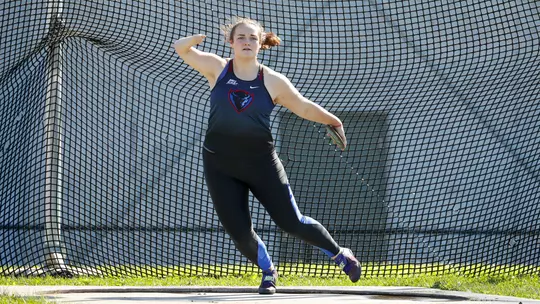
"Ain't No Mountain High Enough" for Noelle Malkamaki
Inspiring Blue Demon thrower overcame congential birth defect
5/5/2020
Take in one performance by Noelle Malkamaki and you'll quickly notice the strength, dedication and persistence of a high-level track and field student-athlete.
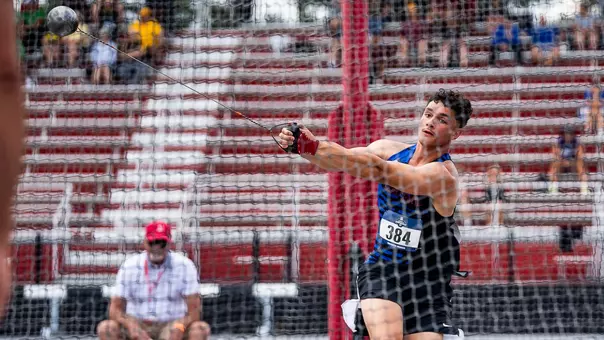
That's what it took for the DePaul freshman to help her St. Teresa high school team in Downstate Decatur finish third at the IHSA state meet in 2018 and 2019. She marked with top-10 finishes in discus and shot put.
Those achievements paved the way for Malkamaki to pursue a track and field career at the NCAA Division I level.
"The last two years of track in high school I was one of the team captains, and that was really fun to not only help lead the team by scoring points but also through motivational support and helping everyone else," Malkamaki said. "Especially once you're an upperclassman, you have to lead the underclassmen. It's nice to play that role."
Malkamaki knew track and field would always be a passion to carry on through her college years.
"Soon as I joined in eighth grade is when I realized this is something I wanted to keep doing," she said. "But I never realized until probably my junior year that I would be able to continue doing this in college. Once I knew it could be possible, I really started devoting a lot more time to it."
While Malkamaki has experienced success throughout her career, she does not discount the obstacles she had to overcome.
Because of a congenital birth defect known as Amniotic band syndrome (ABS), Malkamaki was born with her right arm stopping at her wrist.
Right from the start, she never allowed this to hold her back.
"For lack of a better term, I guess it's like already starting at a disadvantage so I have to work even harder to overcome being behind where everyone else is," she said. "I have to find the motivation and work even harder to bring myself back to even. Having that mindset just pushes you even farther past that."
Malkamaki channels her frustrations into productivity and puts aside everything else.
"With throwing, I feel that's the perfect sport because you get a little mad and use that emotion to get a more explosive throw," she said. "If you're frustrated in the weight room, you can have a bigger lift and a bigger PR (personal record)."
She is thankful working with coaches that train her just like any other student-athlete with the ultimate goal of reaching her potential.
"In the weight room, it can get really frustrating because I want to be doing the high-level stuff which most of the time I can," she said. "Strength coach Ryan Nosak is always super good about it: 'So you can't do a clean lift---here's what we're going to do instead.' I'll be doing stuff with bench press and getting it up there. But every once in a while, I just think: 'Man if I had two hands I could really be doing this.'"
A key to her success is turning a negative mindset into a positive attitude.
"To overcome that, I have to take a step back and realize how great it is what I'm doing---then thinking through realistic and logical ways to get that even better," Malkamaki said. "Obviously, I can't do it like everyone else. So, how can I can get to that same level in a different way by taking a different route?"
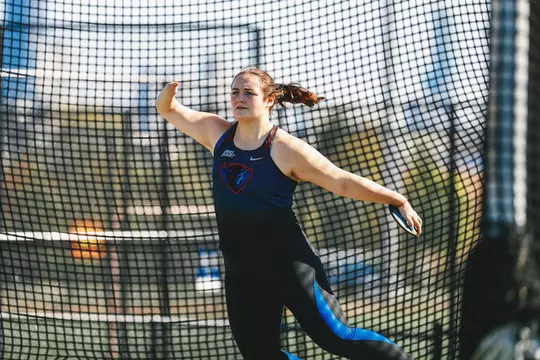
What motivates her the most?
"The biggest motivation is my family," she said. "Since my parents have always been so dedicated and willing to help me with everything in my life, I owe it to them to do the most with what they've helped me to achieve."
Her family's tough love is the origin of a strong work ethic.
"From a super-young, age my parents never looked at me any different than any other kid---which is really fantastic having that standard," she said. "They've never made excuses for me, and that led me to never make excuses for myself. Any mindset or work ethic I have comes from the early standard of going out and getting whatever you want no matter how hard it is."
Malkamaki wants to use her success to inspire other athletes with disabilities to never give up and keep fighting to reach their potential.
"I have a good platform to show other people like this, and I've always been really grateful for that," she said.
Her genuine self-belief and personality inspires not only children, but other athletes who are just as capable of meeting this challenge.
"Being really open about the struggles and what you're able to overcome also helps the parents of younger children with disabilities," she said. "It's like, 'oh my gosh, my child is going to be okay.' My family had the same worries.
"My grandma thought I would never crawl. It was all about showing everyone that doing something a little differently doesn't mean you can't do it just as well or better. I think that's the biggest thing."
Her story is an inspiring, living-and-breathing example of what a strong work ethic and learning to overcome the fear of failure can accomplish. Instead of feeling sorry for herself or making excuses, Malkamaki confronted her world head-on and is already a big-time winner.
What Malkamaki has accomplished in the track and field arena and in life overall can light a path for other disabled athletes and people striving to overcome a disability.