Racing to Find a Cure for Cancer
Ex-DePaul sprinter Bryan Clay's breast cancer vaccine undergoing clinical trials
Bob Sakamoto
8/7/2020
My mom is a breast cancer survivor, and I had an aunt succumb to breast cancer…I am really hoping that the breast cancer vaccine is successful!Bryan Clay, Pfizer Cancer Scientist
CHICAGO – The exemplary path Bryan Clay has tread on his life’s journey has seemingly been guided by an innate sense of self-urgency.
Fortunately, this native son of our state’s capital has been blessed with an athletic body and fast-twitch muscle fibers enabling him to get somewhere in a hurry.
He was always among the fastest runners as a kid growing up in Springfield, eventually using that God-given speed to finish second in the 400-meter dash at an IHSA sectional and qualify for the 1995 state track meet.
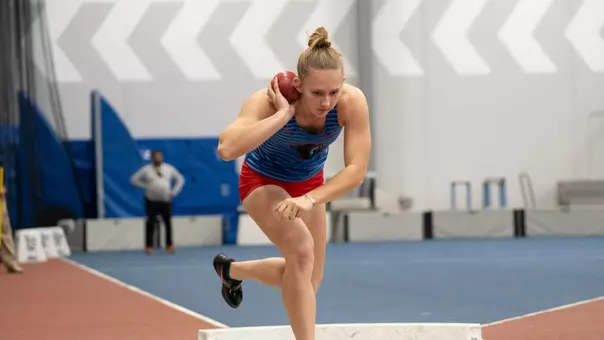
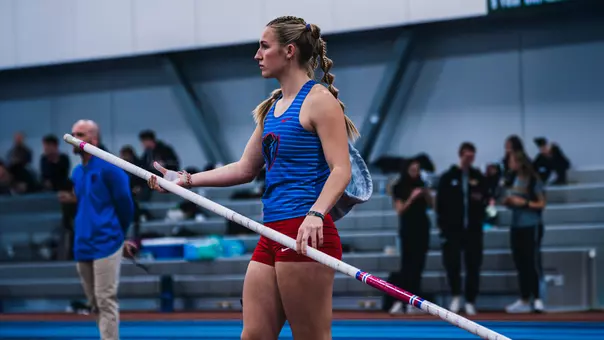
Clay was a top sprinter at DePaul (1995-1999) twice finishing third in the 400 meters at the Conference USA meet and setting indoor and outdoor school records in the 4x400m relay.
And now, our country and even the entire world gets to benefit from Clay’s ongoing competitive drive and urgency as he moves as expeditiously as possible to develop a cure for cancer.
That he works at one of the world’s premier biopharmaceutical companies also puts him in a laboratory “hotspot” of a pandemic that has dominated our lives as the federal government recently signed a $1.95 billion agreement with Pfizer for 100 million doses of an experimental coronavirus vaccine that is expected to undergo clinical trials by the end of the month.
“Pfizer is working on a COVID-19 vaccine, but I am not working on that vaccine,” Clay said. “Our site here in La Jolla, Calif. only works on oncology drugs.
“However, the mRNA technology they use to induce an immune response against COVID-19 could also be used in our cancer vaccines. This vaccine technology is very interesting and is the reason why they can develop a vaccine so quickly. I think one of these companies will be successful in finding a safe and usable coronavirus vaccine.”
As with others who have devoted their lives to cancer research, Clay is motivated by the far-reaching tentacles of this insidious disease that have impacted members of his family.
“Like everyone else in the world, I have been personally affected by breast cancer,” Clay said. “My mom is a breast cancer survivor, and I had an aunt succumb to breast cancer in 1995. Thus, I am really hoping that the breast cancer vaccine is successful!”
His intellectual curiosity and serious academic mindset was evident the moment he set foot in Lincoln Park.
“Coming into DePaul, I was not planning to run track as I wanted to participate in research programs and focus on my schoolwork,” Clay said. “Also, I was unsure if my times would be fast enough to participate at the Division I level.”
That concern was alleviated after meeting Shamar Lott during the school’s inaugural Discover Chicago class.
“Talking with Shamar, I learned that he was on the track team and we had comparable times,” Clay said. “Shamar and Troy Woodard were roommates freshman year which is how I met Troy. I also ended up living with Shamar in the Sanctuary Townhomes sophomore year and off campus our senior year.”
Woodard was another track and field standout who went on to become a highly specialized skull base surgeon at the nationally renowned Cleveland Clinic after graduating from DePaul.
“As Troy and I were both biology majors, we had many classes together,” Clay said. “It was great to have someone as smart as him in my classes and also be a teammate.
“In addition to Troy, there were many other track and field athletes that were biology majors. Carrie Grady and Miranda Fellows were also members of our same class. It was great to have teammates to ask questions and review notes. There were also other fellow student-athletes who were biology majors.”
Clay fondly recalls how his mom and dad were adamant supporters of their children’s pursuits growing up including older sister Theresa who still lives in Springfield and is married with a two kids and older brother Curtis who is married and raising two youngsters in Fairfax, Va.
High points in Bruce and Nell Clay’s 51 years of marriage include faithfully watching their youngest son sprint at Springfield High and following the Blue Demons on track road trips to California, Florida, Texas and other locales.
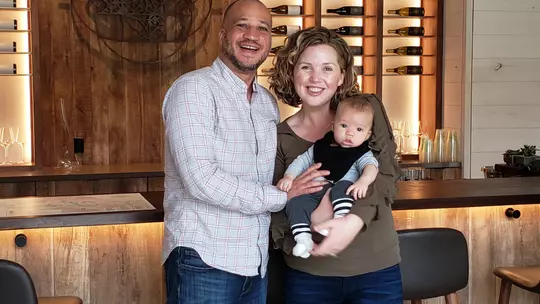
“Many of my fondest memories revolve around family,” said Bryan Clay who is living in San Diego with his wife Kimberly and their first child Bryce who was born last December. “My mom is from the South Side and I still have many family members there.
“Her side of the family has had a family reunion for 70 years, so I always enjoyed traveling to Chicago, Mississippi or wherever the reunion was to visit with my extended family. While growing up, in addition to playing sports, I also enjoyed hunting and fishing with my dad.”
As the DePaul memories came rushing back, Clay smiled about practicing in the hallways of Alumni Hall.
“We (Clay, Lott, Woodard) still joke about trying to sprint on a square track,” Clay said. “But I think that experience at DePaul taught me not to make any excuses for not trying your best and still being able to succeed. Although we often had to run in Alumni Hall and in the unpredictable Chicago spring weather, we still finished better than other Conference USA teams with better facilities.
“Although Bill Leach was my head coach all four years, Dave Dopek was the sprints coach so I spent most of my time with him. It was great having someone who recently graduated from DePaul as a coach. Dave knew exactly what we were going through and how to help us handle the adversity of running track when we did not have a track. He motivated us to work hard and found creative ways to help us succeed.”
Clay’s first foray into the real world after graduating DePaul in 1999 was working at a pharmaceutical manufacturing facility in St. Louis making a drug for hemophilia A patients. The drug is a biologic that is produced in cells called CHO cells, and he helped monitor the cell cultures and performed the first drug purification step.
After a year, Clay took a graduate assistant position at Arizona State in the student-athlete development office and took advantage of the free graduate science classes.
After obtaining his master’s degree, he earned a PhD in Immunology from the University of Chicago in 2008 where his thesis was researching how the immune system induces asthma and allergies.
“I chose immunology as my focus because after my initial job working at a pharmaceutical company, I was interested in returning to pharmaceutical research,” Clay said. “The immune system influences several diseases from autoimmune diseases such as multiple sclerosis, rheumatoid arthritis and lupus to cancer and asthma and many more. I enjoy going to the lab every day with hopes of gaining new knowledge and making new discoveries.”
He found his way to Pfizer in an improbable way.
“People don’t believe this, but I actually received this job (November of 2010) by just blindly applying through the Pfizer website,” Clay said. “My graduate and post-doctorate work was in the field of asthma research. At the time, Pfizer was developing a vaccine that would reduce the asthmatic response. Although the drug went to the clinic, the clinical trials were not successful.
“Since that project, I have worked on developing various cancer vaccines for Pfizer. The goal of cancer vaccines is to induce an immune response targeted to eliminate the tumor.”
That has been a long and difficult process because of a Catch-22 element fundamental to our body’s immune system as Clay explains.
“When you think of a vaccine, you think of a flu vaccine or a vaccine you received as a child to prevent a future infection,” Clay began. “These are called prophylactic vaccines because they prevent a future infection.
“The immune system is pattern-recognition driven and is good at distinguishing self from non-self. When it identifies something in your body that is not yourself such as bacteria or a virus, it recognizes that as a dangerous foreign invader and eliminates it.
“It is easier to create a vaccine against a foreign pathogen because that is how the immune system is designed to work.
“The difficulty with a cancer vaccine is that you are creating an immune response against a tumor which is essentially yourself. You normally do not want the immune system to have an immune response against yourself as this could result in autoimmunity.”
This is where it gets dicey.
“First of all, how do you get the immune system to recognize yourself when it is trained to not react against yourself?” Clay said.
“Secondly, one of the ways the immune system limits an autoimmune response is that it eliminates immune cells that would react against yourself. So how do we initiate an immune response when the cells responsible may not exist?
“Finally, safety is always the most important aspect. So how do we initiate an anti-self-immune response without inducing large-scale auto-immunity?”
It’s a paradox that mandates patience and a relentless pursuit to uncover the solution.
“Although the tumor is essentially your own self, that is not 100 percent true,” Clay said. “The mutations that have allowed the cells to replicate and become a tumor can produce proteins to make the tumor look foreign, and we try and target this when designing a cancer vaccine.
“I have helped in the development of a couple vaccines that are currently undergoing clinical trials. One is for prostate cancer and a second is currently being tested in non-small cell lung cancer and triple negative breast cancer.”
The [DePaul] athletic department truly cared about my success in the classroom just as much as my success on the track.Bryan Clay
The parallels between Clay’s time at DePaul and his search for a cancer vaccine are striking.
“DePaul has contributed to my success in multiple ways,” Clay said. “First, the athletic department truly cared about my success in the classroom just as much as my success on the track. You have many additional labs every quarter as a biology major, and we often had to run off campus. Having coaches that understood the importance of our classes and willing to be flexible with practices was amazing.
“The experience of running track helped establish the hard work and dedication needed to attain my PhD. I was just telling my wife the other day that one thing I liked about track was that success or failure was entirely up to me.”
Clay took momentary leave of San Diego and was back in Lincoln Park.
“When I stepped up to the line in a race, I had control over whether I would try my hardest while realizing I would be in some pain after the race,” he said. “But I always remembered the pain was temporary and the success of getting a new personal best always outweighed the pain.
“Although my race is less than 50 seconds, I spent many hours in the weight room, on the track and on a trainer’s table that people never see just to compete for less than a minute.
“Biomedical research can be frustrating spending many hours performing experiments when many do not work. But if we are able to develop a vaccine that can find a cure for cancer, those hard, long hours will definitely be worth it.”
As was his DePaul experience in the late 1990s.
“I donate to the track team every year,” Clay said. “I recognize that I eventually received the benefit of a track scholarship due to other people’s donations and I try to help the current athletes out by donating to some of the track funds every year.”
If Bryan Clay has his way, the former Blue Demon will one day make a life-changing contribution to help eradicate this country’s second-leading cause of death.