

DePaul University Athletics
2/22/2022 1:02:00 PM | ATHLETICS, TRACK AND FIELD
Celebrating a pre-Title IX pioneer and perhaps DePaul’s all-time greatest athlete
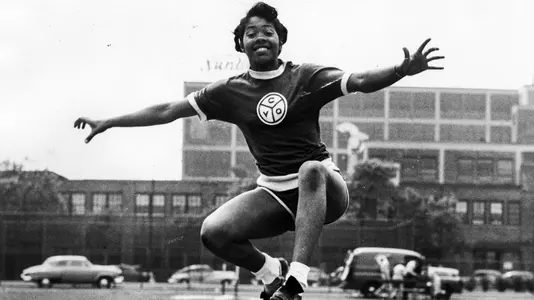
CHICAGO - Mabel Landry Staton is arguably the greatest athlete to ever attend DePaul.
It was just unfortunate that during her time in Lincoln Park in the early 1950s, there was no Blue Demon women's track and field program.
Women, girls and females of all ages had little or no access to sanctioned athletic competition back in those days as we lived in an entirely different world. Although girls and women participated in sports, it went largely unrecognized.
As our nation proudly celebrates the 50th anniversary of Title IX landmark federal legislation that mandated equal and fair treatment for access to college and a life-changing experience, it is wholly imperative that we remember and recognize those trailblazers who paved the way for future generations.
Mabel Landry Staton is truly an honest-to-goodness heroine before her time.
Without a college track and field program, the resourceful Staton trained independently and became a powerful force on the national scene. She wound up proudly representing her country at the 1952 Summer Olympics in Helsinki, Finland.
Today, the 89-year-old DePaul alum is as lively and colorful as ever and continues to live a vibrant and spiritual life since her induction into the DePaul Athletic Hall of Fame in 2011. She lives in Voorhees, N.J with her daughter Paula Staton.
"She calls herself my caretaker," Mabel said with a chuckle. "She has been a blessing."
What brought mother and daughter closer than ever before and tested their considerable faith was a diagnosis in October of 2019 of multiple myeloma---a cancer of plasma cells in the bone marrow.
Adversity has never been able to slow her stride, and the woman who faced hardship with equal parts courage and optimism stared directly into the greatest challenge of her life---and never blinked.
"I'm still kickin' it, maybe just not as high," Staton said with a laugh last year. This sentiment came after a series of radiation and chemotherapy treatments---21 days on, seven days off---resulted in this Mabel-like declaration:
"I feel wonderful---I really do."
The overall five-year survival rate for bone cancer is around 70 percent. It's likely even higher for someone with Staton's fighting spirit and will to live.
"You know, I never considered myself elderly until this pandemic came about," Staton said. "I've been very careful and staying at home.
"I'll be so glad when it's over so I can resume my social life."
Reconnecting with the ebullient and forever-optimistic DePaul alum always leads to heartfelt laughter and a natural high.
Mabel can make your day.
"You're re-running that story about me being DePaul's greatest athlete?" Staton said on Tuesday morning. "Well, if I'm supposed to be their greatest athlete, I feel sorry for poor old DePaul."
Spontaneous and genuine laughter erupted on both sides of the phone.
"I'm doing just wonderful," Staton said. "The cancer is not in remission, but except for some side effects, it doesn't bother me at all. It doesn't stop me from doing anything."
Nothing has ever stopped her before. Why should this be any different?
"This type of cancer is not terminal---there's just no cure."
February is a 28-day celebration when Black History Month and Title IX join hand-in-hand.
"Black History Month means so much, and I'm very happy seeing all the media coverage and recognition like this," Staton said. "People realize that Black lives matter.
"And you know what else? I'm in the same Alpha Kappa Alpha sorority as Vice-President Kamala Harris."
In honor of Black History Month and in tribute to a true pre-Title IX pioneer, here is a reprise of a feature story about Staton that ran on depaulbluedemons.com leading up to her 2011 DePaul Hall of Fame induction.
*****
Jan. 17, 2011
CHICAGO - Whether it's simply the passage of time or genuine, honest-to-goodness modesty, Mabel Landry Staton couldn't believe what she had heard back in October of 2010.
DePaul Athletics Director Jean Lenti Ponsetto had just told Staton that she was being inducted into the DePaul Athletic Hall of Fame on Sunday, Jan. 23rd at McGrath Arena.
"I said: `What?!!'" Staton said. "I was absolutely flabbergasted. It overwhelmed me.
"I just don't feel worthy. What I accomplished was so long ago, back in the 1950s. I was just floored. Then, I felt very humbled and blessed.
"I was shaking my head when Jeanne said: 'Oh come on, Mabel. You know you are one of the greatest female athletes that ever attended our school.'"
It's a shame Blue Demon fans couldn't cheer on this co-holder of the U.S. 50-yard dash record who won five national titles in the 50 and 60-yard dashes and was a four-time long jump champion.
That's because when Staton attended DePaul from 1951-54, there wasn't a women's track team.
Instead, the South Sider burned up the academic track taking full advantage of her academic scholarship, earning top grades and graduating in 1954.
That was two years after her crowning athletic accomplishment---competing in the 1952 Summer Olympics in Helsinki, Finland.
The 19-year-old graduate of St. Elizabeth's on the South Side running for the Catholic Youth Organization (CYO) team was the only long jumper to hit the Olympic team qualifying standard of 18-feet, 3-inches at tryouts.
"At Helsinki, I did a 19-3 in the long jump preliminaries which broke an Olympic record," Staton said. "I was second going into the finals---and then I fouled on my first five jumps.
"It had to be my nerves. I remember looking around, and all the people in the stands were going wild after my jump in the preliminaries.
"In practice, you just work on your steps and then reach for the sky. My coach said: 'Chop your steps so at least you make a mark.'"
Staton finished seventh in the long jump.
"I had almost forgotten, it was so long ago," said Staton, who arrived home Jan. 13 from a trip on the Queen Victoria ocean liner. "The only times I think about it is when the Olympics come around."
Such reflection also revives memories of an American culture still locked up in the jaws of segregation and discrimination.
She chuckled about mischievously sneaking into the whites-only bathrooms and recalled one memorable tale about the Jim Crow South.
Competing in her first national AAU meet, Staton and her coach took a train to Odessa, Texas. To be prepared for nationals, Staton's coach bought her passage in a sleeping compartment while he sat up front.
"In those days, Blacks had to sit in the back on buses and planes," Staton said. "But on trains, they sat up front so the smoke would hit them first."
During the trip, Staton was awakened by a loud banging noise at 6 a.m.
"Get out," a conductor said. "We just crossed the Mason-Dixon Line. You have to go sit up front with the other coloreds."
Staton's coach was furious. After arriving back in Chicago, the CYO sued the Illinois Central Railroad and won.
"That's how we got money to form our track team," said Staton, who had been competing as an independent and was joined by athletes from the all-white Chicago Hurricanes track club who asked to join Staton after her dominating performance in Texas.
"We were the only interracial track team in the Midwest. Living in the era of segregation wasn't a bed of roses. What helped me was my faith and the support of family, coaches and teammates.
"I'll never forget the time I raised my hand in first grade. 'Sister, why are we different from everyone else?'
"The nun replied: 'God gave you color because he loves you more.' "There wasn't any stopping me after that."
Campus life at DePaul opened up Staton's eyes to a world of endless possibilities.
"I was treated royally at DePaul and loved all the interaction with teachers and students," Staton said. "I was invited to join a sorority and became the first black women in the sorority. Going to college was a beautiful experience.
"After I graduated, whenever I applied for jobs, doors opened up whenever I said the name DePaul University. I became the first black woman to work in so many companies.
"It was because of my college education and the name of DePaul."
Staton has been bestowed a number of honors and awards. She has been inducted into the Helms Hall of Fame for women's track and the New Jersey Hall of Fame.
She was presented with the Rosa Parks Award in 2008 and recently received the Lifetime Achievement Award from the South Jersey Track and Field Association.
After the DePaul Hall of Fame induction, Staton will receive the NAACP's Legendary Award in April.
"I've been so blessed," said Staton, a retired New Jersey teacher and track official. "I have one of my daughters coming in from California for the Hall of Fame Banquet and another coming from New Jersey. I have relatives and friends coming.
"There's a wait list for my tables.
"It's going to be a ball."
It was just unfortunate that during her time in Lincoln Park in the early 1950s, there was no Blue Demon women's track and field program.
Women, girls and females of all ages had little or no access to sanctioned athletic competition back in those days as we lived in an entirely different world. Although girls and women participated in sports, it went largely unrecognized.
As our nation proudly celebrates the 50th anniversary of Title IX landmark federal legislation that mandated equal and fair treatment for access to college and a life-changing experience, it is wholly imperative that we remember and recognize those trailblazers who paved the way for future generations.
Mabel Landry Staton is truly an honest-to-goodness heroine before her time.
Without a college track and field program, the resourceful Staton trained independently and became a powerful force on the national scene. She wound up proudly representing her country at the 1952 Summer Olympics in Helsinki, Finland.
Today, the 89-year-old DePaul alum is as lively and colorful as ever and continues to live a vibrant and spiritual life since her induction into the DePaul Athletic Hall of Fame in 2011. She lives in Voorhees, N.J with her daughter Paula Staton.
"She calls herself my caretaker," Mabel said with a chuckle. "She has been a blessing."
What brought mother and daughter closer than ever before and tested their considerable faith was a diagnosis in October of 2019 of multiple myeloma---a cancer of plasma cells in the bone marrow.
Adversity has never been able to slow her stride, and the woman who faced hardship with equal parts courage and optimism stared directly into the greatest challenge of her life---and never blinked.
"I'm still kickin' it, maybe just not as high," Staton said with a laugh last year. This sentiment came after a series of radiation and chemotherapy treatments---21 days on, seven days off---resulted in this Mabel-like declaration:
"I feel wonderful---I really do."
The overall five-year survival rate for bone cancer is around 70 percent. It's likely even higher for someone with Staton's fighting spirit and will to live.
"You know, I never considered myself elderly until this pandemic came about," Staton said. "I've been very careful and staying at home.
"I'll be so glad when it's over so I can resume my social life."
Reconnecting with the ebullient and forever-optimistic DePaul alum always leads to heartfelt laughter and a natural high.
Mabel can make your day.
"You're re-running that story about me being DePaul's greatest athlete?" Staton said on Tuesday morning. "Well, if I'm supposed to be their greatest athlete, I feel sorry for poor old DePaul."
Spontaneous and genuine laughter erupted on both sides of the phone.
"I'm doing just wonderful," Staton said. "The cancer is not in remission, but except for some side effects, it doesn't bother me at all. It doesn't stop me from doing anything."
Nothing has ever stopped her before. Why should this be any different?
"This type of cancer is not terminal---there's just no cure."
February is a 28-day celebration when Black History Month and Title IX join hand-in-hand.
"Black History Month means so much, and I'm very happy seeing all the media coverage and recognition like this," Staton said. "People realize that Black lives matter.
"And you know what else? I'm in the same Alpha Kappa Alpha sorority as Vice-President Kamala Harris."
In honor of Black History Month and in tribute to a true pre-Title IX pioneer, here is a reprise of a feature story about Staton that ran on depaulbluedemons.com leading up to her 2011 DePaul Hall of Fame induction.
*****
Jan. 17, 2011
CHICAGO - Whether it's simply the passage of time or genuine, honest-to-goodness modesty, Mabel Landry Staton couldn't believe what she had heard back in October of 2010.
DePaul Athletics Director Jean Lenti Ponsetto had just told Staton that she was being inducted into the DePaul Athletic Hall of Fame on Sunday, Jan. 23rd at McGrath Arena.
"I said: `What?!!'" Staton said. "I was absolutely flabbergasted. It overwhelmed me.
"I just don't feel worthy. What I accomplished was so long ago, back in the 1950s. I was just floored. Then, I felt very humbled and blessed.
"I was shaking my head when Jeanne said: 'Oh come on, Mabel. You know you are one of the greatest female athletes that ever attended our school.'"
It's a shame Blue Demon fans couldn't cheer on this co-holder of the U.S. 50-yard dash record who won five national titles in the 50 and 60-yard dashes and was a four-time long jump champion.
That's because when Staton attended DePaul from 1951-54, there wasn't a women's track team.
Instead, the South Sider burned up the academic track taking full advantage of her academic scholarship, earning top grades and graduating in 1954.
That was two years after her crowning athletic accomplishment---competing in the 1952 Summer Olympics in Helsinki, Finland.
The 19-year-old graduate of St. Elizabeth's on the South Side running for the Catholic Youth Organization (CYO) team was the only long jumper to hit the Olympic team qualifying standard of 18-feet, 3-inches at tryouts.
"At Helsinki, I did a 19-3 in the long jump preliminaries which broke an Olympic record," Staton said. "I was second going into the finals---and then I fouled on my first five jumps.
"It had to be my nerves. I remember looking around, and all the people in the stands were going wild after my jump in the preliminaries.
"In practice, you just work on your steps and then reach for the sky. My coach said: 'Chop your steps so at least you make a mark.'"
Staton finished seventh in the long jump.
"I had almost forgotten, it was so long ago," said Staton, who arrived home Jan. 13 from a trip on the Queen Victoria ocean liner. "The only times I think about it is when the Olympics come around."
Such reflection also revives memories of an American culture still locked up in the jaws of segregation and discrimination.
She chuckled about mischievously sneaking into the whites-only bathrooms and recalled one memorable tale about the Jim Crow South.
Competing in her first national AAU meet, Staton and her coach took a train to Odessa, Texas. To be prepared for nationals, Staton's coach bought her passage in a sleeping compartment while he sat up front.
"In those days, Blacks had to sit in the back on buses and planes," Staton said. "But on trains, they sat up front so the smoke would hit them first."
During the trip, Staton was awakened by a loud banging noise at 6 a.m.
"Get out," a conductor said. "We just crossed the Mason-Dixon Line. You have to go sit up front with the other coloreds."
Staton's coach was furious. After arriving back in Chicago, the CYO sued the Illinois Central Railroad and won.
"That's how we got money to form our track team," said Staton, who had been competing as an independent and was joined by athletes from the all-white Chicago Hurricanes track club who asked to join Staton after her dominating performance in Texas.
"We were the only interracial track team in the Midwest. Living in the era of segregation wasn't a bed of roses. What helped me was my faith and the support of family, coaches and teammates.
"I'll never forget the time I raised my hand in first grade. 'Sister, why are we different from everyone else?'
"The nun replied: 'God gave you color because he loves you more.' "There wasn't any stopping me after that."
Campus life at DePaul opened up Staton's eyes to a world of endless possibilities.
"I was treated royally at DePaul and loved all the interaction with teachers and students," Staton said. "I was invited to join a sorority and became the first black women in the sorority. Going to college was a beautiful experience.
"After I graduated, whenever I applied for jobs, doors opened up whenever I said the name DePaul University. I became the first black woman to work in so many companies.
"It was because of my college education and the name of DePaul."
Staton has been bestowed a number of honors and awards. She has been inducted into the Helms Hall of Fame for women's track and the New Jersey Hall of Fame.
She was presented with the Rosa Parks Award in 2008 and recently received the Lifetime Achievement Award from the South Jersey Track and Field Association.
After the DePaul Hall of Fame induction, Staton will receive the NAACP's Legendary Award in April.
"I've been so blessed," said Staton, a retired New Jersey teacher and track official. "I have one of my daughters coming in from California for the Hall of Fame Banquet and another coming from New Jersey. I have relatives and friends coming.
"There's a wait list for my tables.
"It's going to be a ball."




Friday, September 11
Friday, September 11
Friday, September 11
Friday, September 11