

DePaul University Athletics
Black Student-Athlete Summit Evokes Powerful Feelings
2/4/2021 1:25:00 PM | ATHLETICS, MEN'S SOCCER, TRACK AND FIELD
Event hosted by Texas a moving experience for Carroll, Watkins, Ingram
CHICAGO – Like a cold slap in the face, Patrick Watkins revealed an experience in which the DePaul men's soccer played was seemingly ensnared in the ugly tentacles of implicit bias and racism.
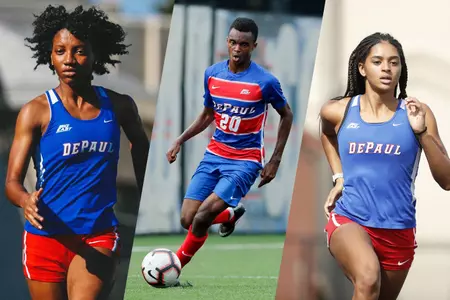
His episode came to light as the men's soccer player along with track and field athletes Tori Carroll and Isabel Ingram represented DePaul at the sixth-annual Black Student-Athlete Summit last month hosted by Texas.
All three Blue Demons are actively involved in their teams' Diversity, Equity and Inclusion committees and are being featured as DePaul Athletics commemorates Black History Month.
More than 1,300 student athletes and collegiate staff professionals participated in the virtual summit that aspired to spark dialogue and conversation about solutions to the challenges and opportunities Black student-athletes encounter on campus.
It certainly ignited a fire within Watkins.
Towards the end of last year he was involved in a Zoom interview process for an appealing internship. By his own admission, this was his first encounter with the interview process. Fully aware that any shortcomings might surface---he looked upon it as a valuable learning experience and was open to all lanes of criticism.
"I was fortunate enough to make it to the final round of interviews," Watkins said. "If you aren't familiar with final interviews, they ask questions in a STAR-based format. The interviewers present you with questions like 'Name a time you were put in this situation, and what did you do to fix it?'
"The best answers would essentially get the position. As a student-athlete, my experiences from playing a sport in college gave me multiple ways to answer these types of questions. I answered away and felt confident.
"I get my call-back from one of the representatives of the company and inquired about who got the internship. It wasn't me, but I was not discouraged at all. In fact, I grabbed a pen and paper right away and asked for critiques of my final interview, realizing I was doing this for the experience.
"The representative told me that the hiring managers from my interview said I had the best answers by far to these STAR-based questions. I was immediately confused because these questions were the determining factors. I figured I must have done something else in my presentation that would have disqualified me.
"The representative then tells me they thought the answers were so good that I was reading off a pre-written script. Mind you, I have NEVER been asked those questions a day in my life, nor did someone tip me off. I was so confused because that was the only critique that was given to me.
"It makes you think. I talked to my parents and they were equally stumped. Once again, the same doubts crept into their minds. Why couldn't I have such terrific responses without a script? I looked the interviewers in their eyes the whole time and didn't move my hands during the session.
"Could someone that looks like me not blow the other candidates out of the water? Why was a pre-written script the only possible reason behind my competence and ability? Those questions go unanswered, but it does make you think. How could I draft responses to questions I don't have? I may not have gotten the job because they genuinely thought I was reading a script, but implicit bias is definitely in the conversation and cannot be ignored."
*****
What moved the needle for Carroll was a presentation by Texas Vice President of Diversity Dr. Leonard Moore on why most universities' diversity plans fail.
Moore said that most universities only create this plan after a crisis happens, which is like a temporary band aid instead of building an everlasting culture. Rifts are created between Black student-athletes and the administration because they often come from completely different backgrounds and do not create a community with each other.
"His speech revolutionized my perspective because he emphasizes the importance of relationship within the athletic department," Carroll said. "Relationship building is critical so when racial issues arise--- whether within the university or on a national platform. Black athletes feel supported instead of isolated."
When asked to describe issues facing Black student-athletes on her team, on campus or in the world we live in, Carroll did not mince words.
"On a national scale, a huge common issue for the Black student-athlete is knowing that often our value is constantly validated by a jersey number or uniform," Carroll said. "But once we step outside of the athletic space, we are not as accepted or as privileged as our counterparts. For many Black student-athletes, we sometimes struggle to intrinsically know our value other than our athletic achievements because it may be the only arena we are seen beyond our weaponized black skin."
Like Watkins, Carroll has witness first-hand an implicit brand of racism and prejudice.
"Even though I am a track-and-field athlete, I have experienced several instances of racism when I was a volleyball player before college," Carroll said. "From being the only black person on one team to transitioning to a mostly Black volleyball team---the treatment from volleyball referees and even other coaches was a complete 180.
"Referees would be quicker to give my Black coaches yellow-card warnings for yelling or being passionate than a Caucasian coach. They would allow other white teams more lenience with play violations than Black teams. While these experiences were frustrating and heartbreaking, they molded me to expect obstacles and not let them affect my athletic performance."
*****
The Black Student-Athlete Summit was a game-changer in many ways for Ingram. She was made aware of signs to look for within herself and her teammates that may be red flags that something is wrong and how to support each other.
What Ingram described as the most surprising and transformational session took place when the student-athletes were split up by gender. The females engaged in "Black Women Living Fearlessly" led by Texas' Fearless Leadership Institute Director Thais Bass-Moore and Diversity & Inclusion specialist Keneshia Colwell.
"They each gave their testimonies which inspired me in a new and needed way," Ingram said. "After they so bravely shared their stories, the student-athletes were able to start sharing a little bit of their own testimonies which included topics on ethnicity, religion, childhood trauma, identity and sports.
"It's somewhat unexplainable how that space turned into the most healing, encouraging, embracing hug I didn't know I needed---but it did. I had never known a place of such community. All strangers in appearance yet so familiar as female student-athletes of color.
"It made me feel heard without speaking, seen without achievements and inspired without having to inspire. Now I want every young, old, boy and girl to feel that. You are not alone. You are important, your story is so important, there are people who want to hear you, and together, we can change the culture in athletics and beyond.
"One courageous young woman said, 'my achievements are no longer my only identity.' I felt that because for so long I had been living behind my achievements, an unattainable perfectionism that many student-athletes struggle with. I had no idea there was a way to progress. So today, and every day I choose to add to my story, add to my identity by being authentic, striving to listen and encouraging that type of community wherever I go."
*****
Reinforced by Dr. Moore's presentation on why some university diversity plans fail, Watkins is going to act on his critiques of DePaul's plan.
Watkins believes there are changes that could lift the diversity plan to a place where Blue Demon student-athletes want to see it go. He plans to emphasize that with his DEI committee after consulting with Carroll and Ingram. Having such difficult talks will hopefully remove barriers, giving way to real impact and change.
"The biggest issues are micro-aggressions and a lack of resources for minority student-athletes here at DePaul," Watkins said. "l think a staff or team of specialists dealing with diversity and inclusion that LOOK like their minority student-athletes would go a long way.
"It's being able to speak to someone about issues that they endured is something that can never go unnoticed. It makes the conversation more authentic. Personally, I feel like I can say what I truly want to say and that specialist will give me back raw and real answers that can actually help me."
Watkins was raw and real when describing the implicit bias he has encountered during his life.
"The amount of back-handed compliments I have received about how articulate I am or teachers and administrators not thinking I could speak well publicly is crazy," he said. "The amount of times I have been called an Oreo or have not been deemed as 'black' is more than I can count. Or when people continually use the joke 'Oh it's because you're black right?' That grin on their face, expecting me to laugh is probably the most annoying."
Carroll found a way to bring her strong feelings to life.
"I embraced Black Lives Matter via social media and the signing of various petitions to incite justice and revise our policing institution through Color of Change," Carroll said about the nation's largest online racial justice organization.
"Earlier last year, I focused on the racial disparities within Death Row. I attempted to share victims' story such as Brendan Bernard and Nathaniel Woods through social media and presentations in hopes for more people to sign their petitions to be removed from Death Row."
Carroll believes the track and field program has her back.
"I feel the diversity of our track and field team and our coaches helped make me feel supported throughout my athletic career at DePaul," she said. "Teammates and our entire coaching staff have continuously extended the olive branch to communicate with them whenever I need support so that has been amazing."
Ingram was asked to share her thoughts on Black Lives Matter, among the most powerful movements in our nation's history, a modern-day version of the 1960s Civil Rights movement led by Dr. Martin Luther King.
"Black Lives Matter is empowering," Ingram said. "It empowered me to use my voice on social media. Although I never had the chance to be in the streets protesting the atrocities that took place in 2020, I so admire those that did and I believe their efforts will not be in vain."
Is there something about the culture of DePaul---whether that be a teammate, coach, teacher, classmate, campus environment, prevailing attitude---that has helped you as a Black student-athlete?
"Inviting student-athletes into the conversation via DEI has been transformational," Ingram said. "There is room for me at the table. I have felt heard, supported and inspired to advocate for my peers.
"This may just be the most progressive and encouraging act I have seen during my time at DePaul, and I cannot tell you enough how much it means to me and my peers to be heard."
His episode came to light as the men's soccer player along with track and field athletes Tori Carroll and Isabel Ingram represented DePaul at the sixth-annual Black Student-Athlete Summit last month hosted by Texas.
All three Blue Demons are actively involved in their teams' Diversity, Equity and Inclusion committees and are being featured as DePaul Athletics commemorates Black History Month.
More than 1,300 student athletes and collegiate staff professionals participated in the virtual summit that aspired to spark dialogue and conversation about solutions to the challenges and opportunities Black student-athletes encounter on campus.
It certainly ignited a fire within Watkins.
Towards the end of last year he was involved in a Zoom interview process for an appealing internship. By his own admission, this was his first encounter with the interview process. Fully aware that any shortcomings might surface---he looked upon it as a valuable learning experience and was open to all lanes of criticism.
"I was fortunate enough to make it to the final round of interviews," Watkins said. "If you aren't familiar with final interviews, they ask questions in a STAR-based format. The interviewers present you with questions like 'Name a time you were put in this situation, and what did you do to fix it?'
"The best answers would essentially get the position. As a student-athlete, my experiences from playing a sport in college gave me multiple ways to answer these types of questions. I answered away and felt confident.
"I get my call-back from one of the representatives of the company and inquired about who got the internship. It wasn't me, but I was not discouraged at all. In fact, I grabbed a pen and paper right away and asked for critiques of my final interview, realizing I was doing this for the experience.
"The representative told me that the hiring managers from my interview said I had the best answers by far to these STAR-based questions. I was immediately confused because these questions were the determining factors. I figured I must have done something else in my presentation that would have disqualified me.
"The representative then tells me they thought the answers were so good that I was reading off a pre-written script. Mind you, I have NEVER been asked those questions a day in my life, nor did someone tip me off. I was so confused because that was the only critique that was given to me.
"It makes you think. I talked to my parents and they were equally stumped. Once again, the same doubts crept into their minds. Why couldn't I have such terrific responses without a script? I looked the interviewers in their eyes the whole time and didn't move my hands during the session.
"Could someone that looks like me not blow the other candidates out of the water? Why was a pre-written script the only possible reason behind my competence and ability? Those questions go unanswered, but it does make you think. How could I draft responses to questions I don't have? I may not have gotten the job because they genuinely thought I was reading a script, but implicit bias is definitely in the conversation and cannot be ignored."
*****
What moved the needle for Carroll was a presentation by Texas Vice President of Diversity Dr. Leonard Moore on why most universities' diversity plans fail.
Moore said that most universities only create this plan after a crisis happens, which is like a temporary band aid instead of building an everlasting culture. Rifts are created between Black student-athletes and the administration because they often come from completely different backgrounds and do not create a community with each other.
"His speech revolutionized my perspective because he emphasizes the importance of relationship within the athletic department," Carroll said. "Relationship building is critical so when racial issues arise--- whether within the university or on a national platform. Black athletes feel supported instead of isolated."
When asked to describe issues facing Black student-athletes on her team, on campus or in the world we live in, Carroll did not mince words.
"On a national scale, a huge common issue for the Black student-athlete is knowing that often our value is constantly validated by a jersey number or uniform," Carroll said. "But once we step outside of the athletic space, we are not as accepted or as privileged as our counterparts. For many Black student-athletes, we sometimes struggle to intrinsically know our value other than our athletic achievements because it may be the only arena we are seen beyond our weaponized black skin."
Like Watkins, Carroll has witness first-hand an implicit brand of racism and prejudice.
"Even though I am a track-and-field athlete, I have experienced several instances of racism when I was a volleyball player before college," Carroll said. "From being the only black person on one team to transitioning to a mostly Black volleyball team---the treatment from volleyball referees and even other coaches was a complete 180.
"Referees would be quicker to give my Black coaches yellow-card warnings for yelling or being passionate than a Caucasian coach. They would allow other white teams more lenience with play violations than Black teams. While these experiences were frustrating and heartbreaking, they molded me to expect obstacles and not let them affect my athletic performance."
*****
The Black Student-Athlete Summit was a game-changer in many ways for Ingram. She was made aware of signs to look for within herself and her teammates that may be red flags that something is wrong and how to support each other.
What Ingram described as the most surprising and transformational session took place when the student-athletes were split up by gender. The females engaged in "Black Women Living Fearlessly" led by Texas' Fearless Leadership Institute Director Thais Bass-Moore and Diversity & Inclusion specialist Keneshia Colwell.
"They each gave their testimonies which inspired me in a new and needed way," Ingram said. "After they so bravely shared their stories, the student-athletes were able to start sharing a little bit of their own testimonies which included topics on ethnicity, religion, childhood trauma, identity and sports.
"It's somewhat unexplainable how that space turned into the most healing, encouraging, embracing hug I didn't know I needed---but it did. I had never known a place of such community. All strangers in appearance yet so familiar as female student-athletes of color.
"It made me feel heard without speaking, seen without achievements and inspired without having to inspire. Now I want every young, old, boy and girl to feel that. You are not alone. You are important, your story is so important, there are people who want to hear you, and together, we can change the culture in athletics and beyond.
"One courageous young woman said, 'my achievements are no longer my only identity.' I felt that because for so long I had been living behind my achievements, an unattainable perfectionism that many student-athletes struggle with. I had no idea there was a way to progress. So today, and every day I choose to add to my story, add to my identity by being authentic, striving to listen and encouraging that type of community wherever I go."
*****
Reinforced by Dr. Moore's presentation on why some university diversity plans fail, Watkins is going to act on his critiques of DePaul's plan.
Watkins believes there are changes that could lift the diversity plan to a place where Blue Demon student-athletes want to see it go. He plans to emphasize that with his DEI committee after consulting with Carroll and Ingram. Having such difficult talks will hopefully remove barriers, giving way to real impact and change.
"The biggest issues are micro-aggressions and a lack of resources for minority student-athletes here at DePaul," Watkins said. "l think a staff or team of specialists dealing with diversity and inclusion that LOOK like their minority student-athletes would go a long way.
"It's being able to speak to someone about issues that they endured is something that can never go unnoticed. It makes the conversation more authentic. Personally, I feel like I can say what I truly want to say and that specialist will give me back raw and real answers that can actually help me."
Watkins was raw and real when describing the implicit bias he has encountered during his life.
"The amount of back-handed compliments I have received about how articulate I am or teachers and administrators not thinking I could speak well publicly is crazy," he said. "The amount of times I have been called an Oreo or have not been deemed as 'black' is more than I can count. Or when people continually use the joke 'Oh it's because you're black right?' That grin on their face, expecting me to laugh is probably the most annoying."
Carroll found a way to bring her strong feelings to life.
"I embraced Black Lives Matter via social media and the signing of various petitions to incite justice and revise our policing institution through Color of Change," Carroll said about the nation's largest online racial justice organization.
"Earlier last year, I focused on the racial disparities within Death Row. I attempted to share victims' story such as Brendan Bernard and Nathaniel Woods through social media and presentations in hopes for more people to sign their petitions to be removed from Death Row."
Carroll believes the track and field program has her back.
"I feel the diversity of our track and field team and our coaches helped make me feel supported throughout my athletic career at DePaul," she said. "Teammates and our entire coaching staff have continuously extended the olive branch to communicate with them whenever I need support so that has been amazing."
Ingram was asked to share her thoughts on Black Lives Matter, among the most powerful movements in our nation's history, a modern-day version of the 1960s Civil Rights movement led by Dr. Martin Luther King.
"Black Lives Matter is empowering," Ingram said. "It empowered me to use my voice on social media. Although I never had the chance to be in the streets protesting the atrocities that took place in 2020, I so admire those that did and I believe their efforts will not be in vain."
Is there something about the culture of DePaul---whether that be a teammate, coach, teacher, classmate, campus environment, prevailing attitude---that has helped you as a Black student-athlete?
"Inviting student-athletes into the conversation via DEI has been transformational," Ingram said. "There is room for me at the table. I have felt heard, supported and inspired to advocate for my peers.
"This may just be the most progressive and encouraging act I have seen during my time at DePaul, and I cannot tell you enough how much it means to me and my peers to be heard."
Players Mentioned


Episode 29: Kacy & Jenna
Thursday, November 13
Blue Demon Room Podcast Episode 17: Rachel Wilhelm and Noreen Vlamakis, Rush Physical Therapy
Wednesday, March 19
Episode 11: DeWayne Peevy, Vice President/Director of Athletics
Wednesday, December 18
Blue Demon Breakdown - Oct. 16
Wednesday, October 16