

DePaul University Athletics
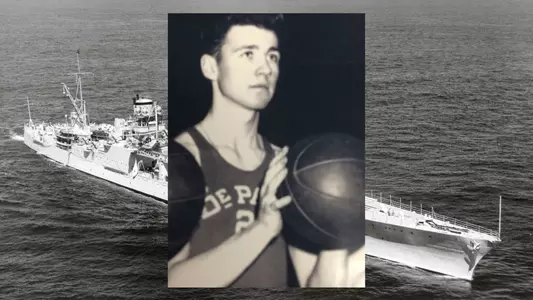
Commemorating Courageous Legacy of Jack Dean
5/11/2021 1:07:00 PM | MEN'S BASKETBALL
Dean's former basketball teammate and friend Jack Phelan passed away in March
(Former DePaul basketball star Jack Phelan, the last surviving player from the 1945 NIT national championship team coached by Ray Meyer and led by the legendary 6-foot, 10-inch center George Mikan, passed away on March 20 at the age of 95 in Bradenton, Fla. after a long battle against cancer.
In the 1940s, the NIT was college basketball's premier postseason event relegating the NCAA tournament to scheduling around the NIT bracket. The 6-5 Phelan suited up for the Blue Demons from 1943-45 before enlisting in the Navy and rejoined Meyer's team from 1947-49 playing forward and back-up center to Mikan. There was a memorable scar on Mikan's elbow from the teeth he knocked out of Phelan's mouth in a practice just before the '45 NIT tournament.
After helping lead DePaul to three NIT Semifinals including one title, Phelan played in the NBA for the Waterloo Hawks, Sheboygan Red Skins and the Ft. Wayne Pistons. He was also a part-time player for the team that played against the world-famous Harlem Globetrotters.
After his playing days, Phelan worked briefly as a salesman for Fox De Luxe Beer in Chicago followed by a highly successful career as a salesman, manager and vice-president of the Nalco Chemical Company whose corporate headquarters are located in west suburban Naperville. He retired to Sarasota, Fla. with his wife Helen in 1986. He relocated to Bradenton after his wife passed away.
One of Jack Phelan's DePaul teammates and close friends was a colorful, unforgettable character named Jack Dean who lived every day of his young life with a certain panache and undeniable flair. All fired up to fight for his country at the height of World War II, Dean enlisted after his freshman season at the age of 18 and was eventually assigned to the ill-fated USS Indianapolis that undertook a top-secret mission delivering the first atomic bomb. His death at the age of 20 and Phelan's connection to Dean are reprised in a story published on Nov. 13, 2018 on depaubluedemons.com.)
CHICAGO – Watching NFL football over the Veterans Day weekend with all the coaches in their green fatigue outfits and watching the special military ceremonies reminded viewers of a special day on the American calendar.
An entire nation pays homage and expresses their gratitude to the men and women who have made the ultimate sacrifice for their country to defend the liberty and freedom we enjoy every day.
Each year when it comes time to commemorate Veterans Day, everyone in the DePaul community should take a moment to cherish the legacy of an inspirational Blue Demon and true American hero named Jack Dean.
Dean arrived on the DePaul campus in the early 1940s living a happy-go-lucky lifestyle back in a bygone era when Lincoln Park, the city of Chicago and the entire United States was so vastly different than today.
This swashbuckler of a guy made an immediate impact on the Blue Demon basketball culture winning over his teammates on the 1943-44 team with a feisty athleticism while at the same time wowing the coeds with his good looks and easy charm.
Legendary coach Ray Meyer with a discerning eye for difference-making talent inserted the 6-foot, 2-inch Dean into the starting lineup at forward right from the get-go and watched this freshman become his third-leading scorer behind All-Americans George Mikan and Dick Triptow.
Folks in the Blue Demon community are aware of the Mikan legacy and how the 6-10 center dominated the collegiate game and went on to star in the NBA with the Minneapolis Lakers, redefining the pro game with his rebounding, shot-blocking and unstoppable hook shot with either hand.
Mikan led the Lakers to five NBA championships and played for coach John Kundla, the grandfather of current DePaul women's basketball standout Rebekah Dahlman. Kundla passed away last year at the age of 101.
Triptow played pro basketball for five years and teamed with Mikan to lead the Chicago Gears to a championship in 1947.
Dean held his own in some pretty heady hoops company and might have eventually joined Mikan and Triptow at the next level except his budding career was cut short.
That Dean only starred at DePaul for one season was a reflection of his determination to serve his country in a time of war and be willing to sacrifice his young life in defense of a cherished freedom.
Dean wound up enlisting in the U.S. Navy after his freshman season, and after stops at the Great Lakes Naval Station in Chicago and the Naval Training Station in San Diego, Calif., he was assigned to the ill-fated USS Indianapolis.
After completing a top-secret mission delivering the first operational atomic bomb to an island 80 miles north of Guam, Dean's ship was sunk by a Japanese submarine and suffered the greatest single loss of life at sea in the history of the U.S. Navy.
Out of 1,196 men on board, almost 300 went down with the ship. The remaining 900 or so men were left floating in shark-infested waters with no lifeboats and most with no food or water. The ship was never missed, and by the time the survivors were spotted by accident four days later, only 317 were still alive.
It was a scene chillingly recounted by the grizzled Robert Shaw shark-hunting character Quint in the movie "Jaws." Here's an excerpt from a survivor named Woody James that's on the website www.ussindianapolis.org.
Day 4
"The sun finally did rise and it got warm again. Some of the guys have been drinking salt water by now, and they were (hallucinating). The day wore on and the sharks were around, hundreds of them. You'd hear guys scream, especially late in the afternoon. Seems like the sharks were worse late in the afternoon than they were during the day. Then, they began feeding at night, too. Everything would be quiet and then you'd hear somebody scream and you knew a shark had got him." James was rescued on day four.
Dean's former teammate Jack Phelan had a chance encounter at dinner with a survivor of the USS Indianapolis.
"I got into a conversation with a gentleman about old-time basketball players," said Phelan who lives in Florida. "I was in the Navy at the end of the war, and this fellow said he had served on the USS Indianapolis. I said that one of my best friends at DePaul had also served on that ship.
"He said that he knew Jack. This man had been in the water with Jack for three days surviving the shark attacks. Then he said: `Jack left us after 2 ½ days.'
"I remember thinking that Jack wasn't even 21 years old yet and had already gone down. Man, I'm so lucky I've had a great life with a wife and a family. Jack never had a chance to do that.
"It was a different world back then, and we were fighting that war for our liberty. The loser of this war is going to be in real sad shape. Jack gave up his life and was an American patriot in every sense of the word."
In an effort to enlighten the DePaul community about Dean, nephew John Tracy headed up a drive to establish the Dean-Tracy Endowed Scholarship for Blue Demon men's and women's basketball. The Tracy in the scholarship name is actually for John's brother Tom Tracy who played at DePaul from 1967-70 on the same teams with Doug Bruno and Joey Meyer. Tom Tracy passed away in 2011.
John Tracy, the longtime coach and dean of students at St Ignatius, passed away in March of 2013. His close friend Jim Corgel picked up the baton and is kick-started the drive for the Dean-Tracy scholarship that will honor Dean's inspirational story.
"John was Jack Dean's nephew and one of my best friends for 38 years," Corgel said. "He told me all about his uncle, and after talking with Doug Bruno, we realized what a meaningful story this is for DePaul. John was the driving force behind the idea of an endowed scholarship.
"When John passed away, I felt it was my responsibility to carry on John's work. In a sense, I'm now representing John Tracy. He was a successful basketball coach for a long time and coached the Bruno boys (Bryan, Kevin, David and Brendan) and Eugene Lenti's girls (Ali and Gena) at St. Ignatius. Tom Tracy was the assistant coach for the Bruno boys.
"John played at Brother Rice, is in Rice's Hall of Fame and was inducted into St. Ignatius' Hall of Fame. He was the leading scorer in the Catholic League in 1964, one year before a guy named Mike Krzyzewski from Weber won the scoring crown.
"John and I first met each other working at IBM in 1975. I became involved with the DePaul community through John, coach Bruno and Athletics Director Jean Lenti Ponsetto. John and I remained friends after I moved to Connecticut in 1988.
"The inspiration to get this going came from John Tracy. We would talk every week for more than 30 years. I miss talking to him."
From what Bruno has heard of Jack Dean, the women's basketball coach sees a striking similarity in Dean's nephew Tom Tracy.
"Tommy was a very fun-loving guy, and from the way people describe Jack Dean, Tommy was very similar to his uncle," Bruno said. "Dean was known as a great basketball player and a lover of life. Tommy was much the same---he loved to hoop and he loved life. He was a good-looking guy like his uncle.
"Tommy was an excellent shooter, and when he was cooking, he'd put up 25, 26 points. Not only was he a great shooter, but he was also a great athlete with terrific hops. He could really rise up. He'd get off the ground and at the peak of his jump release this aesthetically pleasing shot.
"He was a tough guy who didn't act tough or talk tough. I remember going to a Brother Rice-Mt. Carmel game in Carmel's tiny gym when a fight broke out. Tommy was right there in the middle of it.
"I'll never forget the time we were playing at Marquette and Tommy was guarding Jeff Sewell. On their first possession of the second half, they ran a UCLA backdoor screen. Sewell made his move and Tommy denied the cut.
"Sewell pushed Tommy over. Tommy got up and dropped him with one punch."
Ponsetto knows there is a special place in DePaul Athletics for Dean.
"For those at DePaul who know the Jack Dean story, you can only have the utmost respect and admiration for the sacrifice he made as a humanitarian and serviceman who loved his country very deeply," Ponsetto said. "He left behind a promising college basketball career and made the ultimate sacrifice for our freedom with his life. You can only say that he is a true American hero.
"Everyone at DePaul should be really proud of Jack Dean and the great story of a courageous human being who gave up his life in the service of others."
Dean was an incandescent candle that illuminated the world around him.
"He played some tremendous games for us, and I remember one in particular against a U.S. armed services team," Phelan said. "It just didn't happen back then that an 18-year-old kid could start at forward on a very good team.
"Jack was quite a handsome guy and was loved by the girls. It was like he had a thousand young women chasing after him. He was very popular and very much the life of the party wherever he went. He was a happy-go-lucky free spirit who enjoyed every moment.
"We were playing in New York that season and staying at the Paramount Hotel in Times Square. And wouldn't you know it, Jack lined up dates for us with the chorus girls from the well-known Billy Rose's Diamond Horseshoe nightclub made famous by the Betty Grable movie `Diamond Horseshoe.' Well, Jack got hurt in the game that night and all the dates were canceled because Jack couldn't go.
"We were a close-knit team and did everything as a unit. That's the reason we finished second to St. John's in the NIT in 1944 and came back to win the NIT a year later.
"We were in Philadelphia for a game and Jack said: `Let's all get the same ties.' So we went to a local haberdashery and bought these atrocious red, yellow and green ties. We all wore those atrocious things together and got a lot of laughs walking through the hotels in Philly and later, New York."
Phelan has one other special connection to his former teammate.
"I was the first recipient of the Jack Dean Award for Sportsmanship at DePaul in 1949, and that means a lot to me," Phelan said. "I donated the trophy to DePaul where it is displayed in the trophy case as a way of trying to get people to know who Jack Dean was.
"The endowed scholarship in his name is a real inspiration, and I'm so proud of all the people getting behind this effort."
In the 1940s, the NIT was college basketball's premier postseason event relegating the NCAA tournament to scheduling around the NIT bracket. The 6-5 Phelan suited up for the Blue Demons from 1943-45 before enlisting in the Navy and rejoined Meyer's team from 1947-49 playing forward and back-up center to Mikan. There was a memorable scar on Mikan's elbow from the teeth he knocked out of Phelan's mouth in a practice just before the '45 NIT tournament.
After helping lead DePaul to three NIT Semifinals including one title, Phelan played in the NBA for the Waterloo Hawks, Sheboygan Red Skins and the Ft. Wayne Pistons. He was also a part-time player for the team that played against the world-famous Harlem Globetrotters.
After his playing days, Phelan worked briefly as a salesman for Fox De Luxe Beer in Chicago followed by a highly successful career as a salesman, manager and vice-president of the Nalco Chemical Company whose corporate headquarters are located in west suburban Naperville. He retired to Sarasota, Fla. with his wife Helen in 1986. He relocated to Bradenton after his wife passed away.
One of Jack Phelan's DePaul teammates and close friends was a colorful, unforgettable character named Jack Dean who lived every day of his young life with a certain panache and undeniable flair. All fired up to fight for his country at the height of World War II, Dean enlisted after his freshman season at the age of 18 and was eventually assigned to the ill-fated USS Indianapolis that undertook a top-secret mission delivering the first atomic bomb. His death at the age of 20 and Phelan's connection to Dean are reprised in a story published on Nov. 13, 2018 on depaubluedemons.com.)
CHICAGO – Watching NFL football over the Veterans Day weekend with all the coaches in their green fatigue outfits and watching the special military ceremonies reminded viewers of a special day on the American calendar.
An entire nation pays homage and expresses their gratitude to the men and women who have made the ultimate sacrifice for their country to defend the liberty and freedom we enjoy every day.
Each year when it comes time to commemorate Veterans Day, everyone in the DePaul community should take a moment to cherish the legacy of an inspirational Blue Demon and true American hero named Jack Dean.
Dean arrived on the DePaul campus in the early 1940s living a happy-go-lucky lifestyle back in a bygone era when Lincoln Park, the city of Chicago and the entire United States was so vastly different than today.
This swashbuckler of a guy made an immediate impact on the Blue Demon basketball culture winning over his teammates on the 1943-44 team with a feisty athleticism while at the same time wowing the coeds with his good looks and easy charm.
Legendary coach Ray Meyer with a discerning eye for difference-making talent inserted the 6-foot, 2-inch Dean into the starting lineup at forward right from the get-go and watched this freshman become his third-leading scorer behind All-Americans George Mikan and Dick Triptow.
Folks in the Blue Demon community are aware of the Mikan legacy and how the 6-10 center dominated the collegiate game and went on to star in the NBA with the Minneapolis Lakers, redefining the pro game with his rebounding, shot-blocking and unstoppable hook shot with either hand.
Mikan led the Lakers to five NBA championships and played for coach John Kundla, the grandfather of current DePaul women's basketball standout Rebekah Dahlman. Kundla passed away last year at the age of 101.
Triptow played pro basketball for five years and teamed with Mikan to lead the Chicago Gears to a championship in 1947.
Dean held his own in some pretty heady hoops company and might have eventually joined Mikan and Triptow at the next level except his budding career was cut short.
That Dean only starred at DePaul for one season was a reflection of his determination to serve his country in a time of war and be willing to sacrifice his young life in defense of a cherished freedom.
Dean wound up enlisting in the U.S. Navy after his freshman season, and after stops at the Great Lakes Naval Station in Chicago and the Naval Training Station in San Diego, Calif., he was assigned to the ill-fated USS Indianapolis.
After completing a top-secret mission delivering the first operational atomic bomb to an island 80 miles north of Guam, Dean's ship was sunk by a Japanese submarine and suffered the greatest single loss of life at sea in the history of the U.S. Navy.
Out of 1,196 men on board, almost 300 went down with the ship. The remaining 900 or so men were left floating in shark-infested waters with no lifeboats and most with no food or water. The ship was never missed, and by the time the survivors were spotted by accident four days later, only 317 were still alive.
It was a scene chillingly recounted by the grizzled Robert Shaw shark-hunting character Quint in the movie "Jaws." Here's an excerpt from a survivor named Woody James that's on the website www.ussindianapolis.org.
Day 4
"The sun finally did rise and it got warm again. Some of the guys have been drinking salt water by now, and they were (hallucinating). The day wore on and the sharks were around, hundreds of them. You'd hear guys scream, especially late in the afternoon. Seems like the sharks were worse late in the afternoon than they were during the day. Then, they began feeding at night, too. Everything would be quiet and then you'd hear somebody scream and you knew a shark had got him." James was rescued on day four.
Dean's former teammate Jack Phelan had a chance encounter at dinner with a survivor of the USS Indianapolis.
"I got into a conversation with a gentleman about old-time basketball players," said Phelan who lives in Florida. "I was in the Navy at the end of the war, and this fellow said he had served on the USS Indianapolis. I said that one of my best friends at DePaul had also served on that ship.
"He said that he knew Jack. This man had been in the water with Jack for three days surviving the shark attacks. Then he said: `Jack left us after 2 ½ days.'
"I remember thinking that Jack wasn't even 21 years old yet and had already gone down. Man, I'm so lucky I've had a great life with a wife and a family. Jack never had a chance to do that.
"It was a different world back then, and we were fighting that war for our liberty. The loser of this war is going to be in real sad shape. Jack gave up his life and was an American patriot in every sense of the word."
In an effort to enlighten the DePaul community about Dean, nephew John Tracy headed up a drive to establish the Dean-Tracy Endowed Scholarship for Blue Demon men's and women's basketball. The Tracy in the scholarship name is actually for John's brother Tom Tracy who played at DePaul from 1967-70 on the same teams with Doug Bruno and Joey Meyer. Tom Tracy passed away in 2011.
John Tracy, the longtime coach and dean of students at St Ignatius, passed away in March of 2013. His close friend Jim Corgel picked up the baton and is kick-started the drive for the Dean-Tracy scholarship that will honor Dean's inspirational story.
"John was Jack Dean's nephew and one of my best friends for 38 years," Corgel said. "He told me all about his uncle, and after talking with Doug Bruno, we realized what a meaningful story this is for DePaul. John was the driving force behind the idea of an endowed scholarship.
"When John passed away, I felt it was my responsibility to carry on John's work. In a sense, I'm now representing John Tracy. He was a successful basketball coach for a long time and coached the Bruno boys (Bryan, Kevin, David and Brendan) and Eugene Lenti's girls (Ali and Gena) at St. Ignatius. Tom Tracy was the assistant coach for the Bruno boys.
"John played at Brother Rice, is in Rice's Hall of Fame and was inducted into St. Ignatius' Hall of Fame. He was the leading scorer in the Catholic League in 1964, one year before a guy named Mike Krzyzewski from Weber won the scoring crown.
"John and I first met each other working at IBM in 1975. I became involved with the DePaul community through John, coach Bruno and Athletics Director Jean Lenti Ponsetto. John and I remained friends after I moved to Connecticut in 1988.
"The inspiration to get this going came from John Tracy. We would talk every week for more than 30 years. I miss talking to him."
From what Bruno has heard of Jack Dean, the women's basketball coach sees a striking similarity in Dean's nephew Tom Tracy.
"Tommy was a very fun-loving guy, and from the way people describe Jack Dean, Tommy was very similar to his uncle," Bruno said. "Dean was known as a great basketball player and a lover of life. Tommy was much the same---he loved to hoop and he loved life. He was a good-looking guy like his uncle.
"Tommy was an excellent shooter, and when he was cooking, he'd put up 25, 26 points. Not only was he a great shooter, but he was also a great athlete with terrific hops. He could really rise up. He'd get off the ground and at the peak of his jump release this aesthetically pleasing shot.
"He was a tough guy who didn't act tough or talk tough. I remember going to a Brother Rice-Mt. Carmel game in Carmel's tiny gym when a fight broke out. Tommy was right there in the middle of it.
"I'll never forget the time we were playing at Marquette and Tommy was guarding Jeff Sewell. On their first possession of the second half, they ran a UCLA backdoor screen. Sewell made his move and Tommy denied the cut.
"Sewell pushed Tommy over. Tommy got up and dropped him with one punch."
Ponsetto knows there is a special place in DePaul Athletics for Dean.
"For those at DePaul who know the Jack Dean story, you can only have the utmost respect and admiration for the sacrifice he made as a humanitarian and serviceman who loved his country very deeply," Ponsetto said. "He left behind a promising college basketball career and made the ultimate sacrifice for our freedom with his life. You can only say that he is a true American hero.
"Everyone at DePaul should be really proud of Jack Dean and the great story of a courageous human being who gave up his life in the service of others."
Dean was an incandescent candle that illuminated the world around him.
"He played some tremendous games for us, and I remember one in particular against a U.S. armed services team," Phelan said. "It just didn't happen back then that an 18-year-old kid could start at forward on a very good team.
"Jack was quite a handsome guy and was loved by the girls. It was like he had a thousand young women chasing after him. He was very popular and very much the life of the party wherever he went. He was a happy-go-lucky free spirit who enjoyed every moment.
"We were playing in New York that season and staying at the Paramount Hotel in Times Square. And wouldn't you know it, Jack lined up dates for us with the chorus girls from the well-known Billy Rose's Diamond Horseshoe nightclub made famous by the Betty Grable movie `Diamond Horseshoe.' Well, Jack got hurt in the game that night and all the dates were canceled because Jack couldn't go.
"We were a close-knit team and did everything as a unit. That's the reason we finished second to St. John's in the NIT in 1944 and came back to win the NIT a year later.
"We were in Philadelphia for a game and Jack said: `Let's all get the same ties.' So we went to a local haberdashery and bought these atrocious red, yellow and green ties. We all wore those atrocious things together and got a lot of laughs walking through the hotels in Philly and later, New York."
Phelan has one other special connection to his former teammate.
"I was the first recipient of the Jack Dean Award for Sportsmanship at DePaul in 1949, and that means a lot to me," Phelan said. "I donated the trophy to DePaul where it is displayed in the trophy case as a way of trying to get people to know who Jack Dean was.
"The endowed scholarship in his name is a real inspiration, and I'm so proud of all the people getting behind this effort."
DePaul Men's Basketball Game Highlights vs. Georgetown - 03.11.26
Thursday, March 12
Men's Basketball Media Availability: Chris Holtmann & NJ Benson 03.09.26
Monday, March 09
Men's Basketball vs Butler Postgame Press Conference
Sunday, March 08
BIG EAST Tournament Hype Video
Saturday, March 07