

DePaul University Athletics
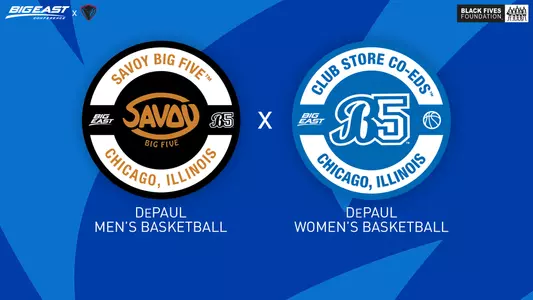
BIG EAST Honors Black Fives Era with 22 Games Across Entire Conference
2/1/2022 10:25:00 AM | ATHLETICS, MEN'S BASKETBALL, WOMEN'S BASKETBALL
DePaul is proud to represent Chicago's Club Store Co-Ed and Savoy Black Five
NEW YORK -- During the month of February, the BIG EAST Conference will celebrate Black History Month by partnering with the Black Fives Foundation, a nonprofit public charity whose mission is to research, preserve, showcase, teach, and honor the pre-NBA history of African Americans in basketball, to host 22 games honoring Black athletes, coaches, and communities who played a critical part in America's basketball history.
After basketball was invented in 1891, teams were often called "fives," for their five starting players. The sport, like society, was racially segregated, and all-Black squads were called "Black fives." From 1904, when basketball was first introduced to African Americans on a wide scale organized basis, through the racial integration of all-White professional leagues in the 1940's, dozens of Black fives emerged and thrived while their skill, athleticism, and innovative styles of play helped shape and popularize the game to know and love today.
"Our basketball-centric identity and commitment to diversity and inclusion creates an optimal conference-wide platform for our men's and women's basketball teams to honor the Black Fives Era and educate individuals on this significant time in Black history," said BIG EAST Commissioner, Val Ackerman. "This is an opportunity to celebrate pioneers in the member schools' communities and to highlight their impact on the game of basketball and the community as a whole."
Black Fives flourished on the amateur, semi-professional and professional levels in cities like New York City, Washington, D.C., Philadelphia, and Chicago, as well as in other locations with substantial African American populations. The men and women of the Black Fives Era opened doors for generations of African American players and coaches while staging culturally rich, socially meaningful events that strengthened and inspired Black communities in the face of Jim Crow oppression.
For 22 games, the BIG EAST Men's and Women's Basketball Teams will be wearing the name and logo of a Black Fives Team to honor these pioneers. Coaches will wear a "Make History Now" pin to draw awareness to the Foundation's mission, and fans will be educated through videos and other game time promotions on the relevance and importance of the Black Fives.
DePaul will honor the Savoy Big Five with the men's basketball team and the Club Store Co-Eds with the women's basketball team. The Black Fives game for the women's team is this Friday when the Blue Demons take on Creighton at 7 p.m. while the Feb. 9 game against Georgetown is the Black Fives game for the men's team.
About the Club Store Co-Eds
The Club Store Co-Eds were a pioneering all-Black women's basketball team formed on the South Side of Chicago in 1930 by entrepreneurial African American nightclub promoter Dick Hudson. With financial backing by the Club Store, a Black-run community cooperative shop located at East 47th and Wabash Avenue in Bronzeville, the Co-Eds featured an all-star lineup that included 6-foot 7-inch center Helen "Streamline" Smith and played their home games at the South Side's renowned Eighth Regiment Armory. Hudson envisioned a national stage for the Co-Eds and shortly after forming the squad he took them on an extensive West Coast tour with stops in Wisconsin, Minnesota, Iowa, and Colorado as well as Canadian stops in Alberta and British Columbia, making them the first all-Black female barnstorming squad in history. On the road, they were nicknamed the Chocolate Co-Eds and Smith was promoted as the "tallest woman in the world." But this was not a comedy act. Playing straight basketball, they became so dominant that other women's teams refused to play them, so Hudson scheduled games against men's teams instead. At one point, the Co-Eds defeated forty-one all-male squads in a row, and in a typical season they traveled over 10,000 miles covering dozens of states while scheduling up to 100 games. The success of the Club Store Co-Eds helped expand the image, definition, and realm of the African American female athlete while also promoting race relations, gender equity, and economic empowerment for Black women for Black women overall during a time when these concepts were new to most Americans.
About the Savoy Big Five
After the Savoy Ballroom opened on the South Side of Chicago in 1927, enterprising African American nightclub promoter Dick Hudson, who managed and coached an all-Black basketball squad known as the Giles Post American Legion Five, made a deal with the owner. Hudson's team could use the colossal new facility as its home court in return for renaming themselves as the Savoy Big Five. The ballroom opened on Thanksgiving Eve, 1927 and the Savoy Big Five began playing there with a roster that included former star players with Chicago city basketball champion Wendell Phillips High School, as well as Joe Lillard, a future NFL halfback. During that first 1927-28 season, the Savoys beat several formidable opponents including Lincoln University of Pennsylvania, Wilberforce University, and the powerhouse Loendi Big Five of Pittsburgh. But as that season ended, a faction of the team broke off to form a new squad called the Harlem Globe Trotters, with Hudson as manager. Soon afterward, Hudson hired a young Chicago-area Jewish sports promoter named Abe Saperstein as the 'Trotters' booking agent. Meanwhile, the Savoy Big Five regrouped for the 1928-29 season and opened the season with a decisive 29-21 win over their local National Basketball League rival, the Chicago Bruins. "I want you to know that this game was no fluke," the ballroom's Jewish owner, I. Jay Faggen, told the New York Age. "We'll beat the Bruins every day of the week." Faggen even suggested that his Savoys should represent the city in the all-White NBL instead of the Bruins, which were owned by George Halas, an original founder of the NFL. "The best team Chicago can get up should represent this city, it does not matter what color the players are."
"We are excited about partnering with the BIG EAST Conference for this educational initiative to raise awareness about the pre-NBA history of African Americans in basketball," said Claude Johnson, Executive Director of the Black Fives Foundation. "We're thrilled to tell the stories of the players and teams from each of its member school regions, whose pioneering contributions helped shape the sport we know and love today. Exploring this history will be especially meaningful because BIG EAST member schools are among the finest academic institutions in the world. We are proud and honored to be working with the BIG EAST Conference."
This is the first time that basketball programs across an entire athletic conference (either collegiate or professional) have come together to honor the Black Fives and showcase the impact these pioneering teams had on the sport.
Fans can follow all of the BIG EAST Black History Month initiatives on Twitter and Instagram at @BIGEAST.
After basketball was invented in 1891, teams were often called "fives," for their five starting players. The sport, like society, was racially segregated, and all-Black squads were called "Black fives." From 1904, when basketball was first introduced to African Americans on a wide scale organized basis, through the racial integration of all-White professional leagues in the 1940's, dozens of Black fives emerged and thrived while their skill, athleticism, and innovative styles of play helped shape and popularize the game to know and love today.
"Our basketball-centric identity and commitment to diversity and inclusion creates an optimal conference-wide platform for our men's and women's basketball teams to honor the Black Fives Era and educate individuals on this significant time in Black history," said BIG EAST Commissioner, Val Ackerman. "This is an opportunity to celebrate pioneers in the member schools' communities and to highlight their impact on the game of basketball and the community as a whole."
Black Fives flourished on the amateur, semi-professional and professional levels in cities like New York City, Washington, D.C., Philadelphia, and Chicago, as well as in other locations with substantial African American populations. The men and women of the Black Fives Era opened doors for generations of African American players and coaches while staging culturally rich, socially meaningful events that strengthened and inspired Black communities in the face of Jim Crow oppression.
For 22 games, the BIG EAST Men's and Women's Basketball Teams will be wearing the name and logo of a Black Fives Team to honor these pioneers. Coaches will wear a "Make History Now" pin to draw awareness to the Foundation's mission, and fans will be educated through videos and other game time promotions on the relevance and importance of the Black Fives.
DePaul will honor the Savoy Big Five with the men's basketball team and the Club Store Co-Eds with the women's basketball team. The Black Fives game for the women's team is this Friday when the Blue Demons take on Creighton at 7 p.m. while the Feb. 9 game against Georgetown is the Black Fives game for the men's team.
About the Club Store Co-Eds
The Club Store Co-Eds were a pioneering all-Black women's basketball team formed on the South Side of Chicago in 1930 by entrepreneurial African American nightclub promoter Dick Hudson. With financial backing by the Club Store, a Black-run community cooperative shop located at East 47th and Wabash Avenue in Bronzeville, the Co-Eds featured an all-star lineup that included 6-foot 7-inch center Helen "Streamline" Smith and played their home games at the South Side's renowned Eighth Regiment Armory. Hudson envisioned a national stage for the Co-Eds and shortly after forming the squad he took them on an extensive West Coast tour with stops in Wisconsin, Minnesota, Iowa, and Colorado as well as Canadian stops in Alberta and British Columbia, making them the first all-Black female barnstorming squad in history. On the road, they were nicknamed the Chocolate Co-Eds and Smith was promoted as the "tallest woman in the world." But this was not a comedy act. Playing straight basketball, they became so dominant that other women's teams refused to play them, so Hudson scheduled games against men's teams instead. At one point, the Co-Eds defeated forty-one all-male squads in a row, and in a typical season they traveled over 10,000 miles covering dozens of states while scheduling up to 100 games. The success of the Club Store Co-Eds helped expand the image, definition, and realm of the African American female athlete while also promoting race relations, gender equity, and economic empowerment for Black women for Black women overall during a time when these concepts were new to most Americans.
About the Savoy Big Five
After the Savoy Ballroom opened on the South Side of Chicago in 1927, enterprising African American nightclub promoter Dick Hudson, who managed and coached an all-Black basketball squad known as the Giles Post American Legion Five, made a deal with the owner. Hudson's team could use the colossal new facility as its home court in return for renaming themselves as the Savoy Big Five. The ballroom opened on Thanksgiving Eve, 1927 and the Savoy Big Five began playing there with a roster that included former star players with Chicago city basketball champion Wendell Phillips High School, as well as Joe Lillard, a future NFL halfback. During that first 1927-28 season, the Savoys beat several formidable opponents including Lincoln University of Pennsylvania, Wilberforce University, and the powerhouse Loendi Big Five of Pittsburgh. But as that season ended, a faction of the team broke off to form a new squad called the Harlem Globe Trotters, with Hudson as manager. Soon afterward, Hudson hired a young Chicago-area Jewish sports promoter named Abe Saperstein as the 'Trotters' booking agent. Meanwhile, the Savoy Big Five regrouped for the 1928-29 season and opened the season with a decisive 29-21 win over their local National Basketball League rival, the Chicago Bruins. "I want you to know that this game was no fluke," the ballroom's Jewish owner, I. Jay Faggen, told the New York Age. "We'll beat the Bruins every day of the week." Faggen even suggested that his Savoys should represent the city in the all-White NBL instead of the Bruins, which were owned by George Halas, an original founder of the NFL. "The best team Chicago can get up should represent this city, it does not matter what color the players are."
"We are excited about partnering with the BIG EAST Conference for this educational initiative to raise awareness about the pre-NBA history of African Americans in basketball," said Claude Johnson, Executive Director of the Black Fives Foundation. "We're thrilled to tell the stories of the players and teams from each of its member school regions, whose pioneering contributions helped shape the sport we know and love today. Exploring this history will be especially meaningful because BIG EAST member schools are among the finest academic institutions in the world. We are proud and honored to be working with the BIG EAST Conference."
This is the first time that basketball programs across an entire athletic conference (either collegiate or professional) have come together to honor the Black Fives and showcase the impact these pioneering teams had on the sport.
Fans can follow all of the BIG EAST Black History Month initiatives on Twitter and Instagram at @BIGEAST.
Wednesday, June 03
Thursday, November 13
Wednesday, March 19
Wednesday, December 18