DePaul University Athletics
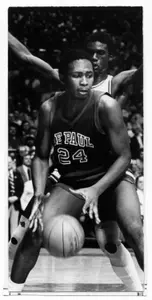
Aguirre Still Hurting From 1980 Summer Olympics Boycott
2/24/2014 12:00:00 AM | MEN'S BASKETBALL
Feb. 24, 2014
CHICAGO – Some powerful emotions came flooding back to DePaul basketball legend Mark Aguirre at the conclusion of the Winter Olympics in Sochi, Russia.
Aguirre was a standout on the 1980 United States Olympic Basketball Team that was poised to win its second consecutive gold medal and ninth in 10 Olympics Games until being denied that opportunity because of the USA Olympic boycott of the 1980 Summer Games in Moscow during the Cold War Era.
It was the last time the Olympics were held in Russia until the 2014 Winter Games.
The 1980 American team coached by the founding force of the BIG EAST Conference Dave Gavitt featured a dozen collegiate stars who would all become NBA first-round draft picks.
Aguirre was the No. 1 pick in the 1980 NBA Draft followed in order by Olympian teammates Isiah Thomas, Buck Williams, Al Wood and Danny Vranes.
Team USA also boasted 7-foot, 1-inch Sam Bowie who was picked just ahead of Michael Jordan in the 1984 draft, 7-0 Alton Lister, Aguirre’s eventual Dallas teammate Rolando Blackman and Rodney McCray, who led Louisville to the 1980 NCAA title and was the third overall pick in the 1983 NBA Draft.
You can imagine with that abundance of athleticism and talent how excited Aguirre was to showcase USA basketball on the world stage.
“On the day before the Olympic Trials were over, they let you know who made the team,” said Aguirre who dominated in the tryouts. “I was elated. It was a very rare opportunity. Out of all the basketball players in the USA, they picked you. It was something to cherish forever.”
On Christmas Eve of that year, Russian troops invaded Afghanistan. In response, President Jimmy Carter led the Olympic boycott in which 65 countries stayed home.
“I don’t remember where I was when I found out about the boycott, but all I know is that it was a terrible day,” Aguirre said. “It was so bad.
“Everyone on our team had put in so much work and effort. We were so enthusiastic and fired up to go and compete for the gold medal. All of us knew we had a great chance to bring that home to America.
“Then, for us not to compete was an unbelievably huge letdown. It still hurts---even to this day. We didn’t even have a chance to compete.”
Realizing the political ramifications of Carter’s move didn’t help to alleviate the overwhelming disappointment.
“Back then, sure, I had an understanding of why it was happening,” Aguirre said. “But then you think of all the other countries who decided to go (Great Britain, Mexico, Greece, Italy, Sweden, Australia, Ireland among others)---and we didn’t.
“As an athlete, you don’t think of it politically. You just wanted to go over there and represent your country. None of us had ever done that before.
“Normally, the good thing about sports is that you don’t get involved with other issues like that. Most of the time, politics is separate from sports.”
Perhaps one of the most empty consolation gestures of all time was the creation of the “Gold Medal Series” where Aguirre and his teammates barnstormed around the country playing exhibition games against squads of NBA players.
The 1980 Olympic Team won 97-84 in Los Angeles and followed up with a 97-66 thrashing of the pros in Phoenix.
“It was fun, but it wasn’t the same thing,” Aguirre said. "We played against NBA all-star teams and won the first two games.
“They took us lightly at first, and it wasn’t good for the NBA’s image that a team of college all-stars was beating them. They started stacking the team with the top NBA all-stars after we won the first two games, but still went 2-1 after that.”
Team USA concluded the exhibition tour with an 81-77 victory over a team of 1976 USA Olympians.
“The Winter Olympics in Sochi, Russia reminded me about 1980 and the Cold War between our country and the Soviet Union,” Aguirre said. “I always believed that the Olympics are supposed to be about athletics and watching the best athletes in the world compete against each other.
“We’re realizing that some of the remnants of the Cold War are still there. Even today, from all the reports coming out of Russia, there appears to be some political oppression still going on there.”
Aguirre said he began preparing for an Olympic opportunity early in his career at DePaul.
“Coach Ray Meyer was always so well-connected with the Olympic basketball situation,” Aguirre said. “He told me very early in my career to get myself mentally prepared to represent the USA. Even before we reached the Final Four in my freshman year, he was grooming me to be an Olympian.
“When you are representing your country, there are things you don’t do. You do always want to portray unity. You have to remember that everywhere you go, whether you’re out to dinner or whatever, you are being looked at and watched. Whether you’re approached by fans or being seen with kids, whatever impression you make will reflect on the USA.
“But that’s how I acted at DePaul, and I planned to carry that over to the Olympics. In the same way I wanted to portray the best of DePaul, I would do the same for the USA.”
There is still a tone of regret in Aguirre’s voice as he reminisces about the lost opportunity.
“When I think about my career, I competed in the state tournament in high school with Westinghouse,” Aguirre said. “In college, I made it to the Final Four with DePaul. In the NBA, I won two titles with the Detroit Pistons.
“By going to the Olympics and winning a gold medal---that would have completed my career. Think about it. You would have competed at the highest level. I would have played at the pinnacle of high school, college, NBA and Olympic basketball.
“I would have competed in the championship round at every level and won some titles.”