DePaul University Athletics
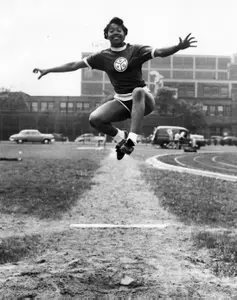
DePaul Celebrates Staton's Illustrious Legacy
2/18/2016 12:00:00 AM | TRACK AND FIELD
CHICAGO – There was a sense of pride and admiration when Mabel Landry Staton was inducted into the DePaul Athletic Hall of Fame in January of 2011.
It was a shame that Staton attended classes and graduated from DePaul but could never showcase her amazing track and field skills because the school did not have a women’s track program back in the early 1950s.
Instead, this remarkable athlete from the city’s South Side competed in Catholic Youth Organization (CYO) events and rose up to win national AAU track and field championships titles.
She reached the pinnacle of amateur sports competing in the 1952 Summer Olympics at Helsinki, Finland.
All those in the DePaul community who came out to commemorate that induction five years ago and everybody on campus today who have gained a genuine appreciation of Staton’s accomplishments will share in celebrating this unique alumna during Black History Month.
True to her nature, Staton said she was “absolutely flabbergasted and overwhelmed” when she was notified by DePaul Athletics Director Jean Lenti Ponsetto about the honor.
“I just don’t feel worthy” Staton said five years ago. “What I accomplished was so long ago, back in the 1950s. I was just floored. Then, I felt very humbled and blessed.
“I was shaking my head when Jeanne said: ‘Oh come on, Mabel. You know you are one of the greatest female athletes that ever attended our school.’”
The induction was the first in an extraordinary series of honors for the Olympian nicknamed “Dolly” by her family. Just three months later in April, she was the recipient of the NAACP Visionary Leader Award. The very next month, the South Jersey Track and Field Association presented Staton with its Unsung Hero Award.
In September of 2011, the New Jersey resident flew back to Chicago and was inducted into the Chicagoland Sports Hall of Fame.
“To be selected to the Chicagoland Sports Hall of Fame and joining people like Muhammad Ali, Michael Jordan and Walter Payton was such a wonderful feeling and such a prestigious honor,” Staton said. “I was so grateful and felt so complimented. I was glad someone thought that I was worthy.”
In 2013, Staton was honored with the Camden County Woman of Distinction Award. The retired New Jersey teacher and current track official has been inducted into the Helms Hall of Fame for women’s track and field and the New Jersey Hall of Fame. She was presented with the Rosa Parks Award in 2008.
Staton stays busy officiating at track meets at the age of 83, mentoring young women and working out regularly at her fitness club. She will take the annual test on Feb. 24 to be re-certified as a track official.
“I’m still kicking,” she said with a laugh. “I don’t take any medications and have no medical problems. I’m healthy and enjoy staying involved in track and mentoring young people.”
It’s too bad Blue Demon fans missed out on the chance to cheer on this co-holder of the U.S. 50-yard dash record who won five national titles in the 50 and 60-yard dashes and was a four-time long jump champion. She won her first national title at the age of 16.
The superb sprinter-long jumper won a total of nine national championships. She was the AAU outdoor long jump champion in 1949-50, and 1952-54, the AAU outdoor 50-yard champion in 1953-54, and the AAU indoor 60-yard champion in 1953-54.
Staton also won the Olympic Trials in the long jump in 1952. At the 1955 Pan-American Games she won a bronze medal in the 60-meter dash and a gold medal in the 4×100-meter relay.
At the same time, the South Sider burned up the academic track at DePaul---taking full advantage of her academic scholarship, earning top grades and graduating in 1954 two years after the Helsinki Olympics.
After graduating from St. Elizabeth’s on the South Side, she began running for the CYO team and was the only long jumper to hit the Olympic team qualifying standard of 18-feet, 3-inches at tryouts.
“At Helsinki, I did a 19-3 in the long jump preliminaries which broke an Olympic record,” Staton said. “I was second going into the finals---and then I fouled on my first five jumps.
“It had to be my nerves. I remember looking around, and all the people in the stands were going wild after my jump in the preliminaries.
“In practice, you just work on your steps and then reach for the sky. My coach said: ‘Chop your steps so at least you make a mark.’”
Staton wound up finishing seventh in the long jump.
“I had almost forgotten, it was so long ago,” Staton said. “The only times I think about it is when the Olympics come around.”
Such reflection also revives memories of an American culture back in the 1950s still locked up in the jaws of segregation and discrimination.
She chuckled about mischievously sneaking into the whites-only bathrooms and recalled one memorable tale about the Jim Crow South.
Competing in her first national AAU meet, the 16-ywear-old Staton and her coach took a train to Odessa, Texas. To be prepared for nationals, Staton’s coach bought her passage in a sleeping compartment while he sat up front.
“In those days, blacks had to sit in the back on buses and planes,” Staton said. “But on trains, they sat up front so the smoke would hit them first.”
During the trip, Staton was awakened by a loud banging noise at 6 a.m.
“Get out,” a conductor said. “We just crossed the Mason-Dixon Line. You have to go sit up front with the other coloreds.”
Staton’s coach was furious. After arriving back in Chicago, the CYO sued the Illinois Central Railroad and won.
“That’s how we got money to form our track team,” said Staton, who had been competing as an independent and was joined by athletes from the all-white Chicago Hurricanes track club who asked to join Staton after watching her dominating performance in Texas.
“We were the only interracial track team in the Midwest. Living in the era of segregation wasn’t a bed of roses. What helped me was my faith and the support of family, coaches and teammates.
“I’ll never forget the time I raised my hand in first grade. ‘Sister, why are we different from everyone else?’
“The nun replied: ’God gave you color because he loves you more.’ “There wasn’t any stopping me after that.”
Campus life at DePaul opened up Staton’s eyes to a world of endless possibilities.
“I was treated royally at DePaul and loved all the interaction with teachers and students,” Staton said. “I was invited to join a sorority and became the first black woman in the sorority. Going to college was a beautiful experience.
“After I graduated, whenever I applied for jobs, doors opened up whenever I said the name DePaul University. I became the first black woman to work in so many companies.
“It was because of my college education and the name of DePaul.”
In looking back on her life including all the monumental accomplishments and everything that she has endured, Staton said: “I’ve made the ultimate long jump from the record-breaking days of my past to the unexpected recognition of the present during my septuagenarian years.
“The induction at DePaul set off a wonderful chain of events. I was so overwhelmed by all the attention, love and support of DePaul. It was such a surprise, and I’ll never get over it.
“You know, I’ve been so blessed.”