DePaul University Athletics
Bryant's Life Story an Inspirational Tale
2/24/2016 12:00:00 AM | MEN'S BASKETBALL
CHICAGO -- There's nothing like curling up to a colorful tale in the midst of a winter snowstorm, and that's exactly what you'll find in the life story of DePaul basketball great Emmette Bryant.
It's a once-upon-a-time narrative about a Damon Runyonesque character who rose up from rough-and-tumble teenage years and reform school to graduate from college and go on to win an NBA championship with the Boston Celtics.
Along the way of a precarious path that could have veered off in the wrong direction at any time, Bryant encountered Secretary of State Jesse White, the Air Force and a legendary coach named Ray Meyer.
Bryant's remarkable accomplishments are something everyone in the DePaul community can share in celebration of Black History Month.
In his three seasons at DePaul, Bryant led the Blue Demons to NIT appearances in 1963 and 1964 at a time when the Madison Square Garden event was equal in stature to the NCAA tournament. DePaul did not belong to a conference in those days, instead taking on independent powers such as Notre Dame, Marquette, St. John's, Georgetown, Syracuse, Louisville, Miami, Villanova, Houston and Seattle.
"People still talked about the legendary George Mikan when I was here, and Howie Carl kept the basketball tradition alive until my years (1961-64) playing with guys like M.C. Thompson from Marshall, Bill Debes from Fenwick, Jesse Nash from Wells---Chicago kids playing lights-out basketball. We also had Dick Cook and Jim Murphy to keep it going.
"My senior year when Jesse and I both scored about 18 points a game, I remember starting out 13-0 and winning the Queen City tournament in Buffalo, N.Y. Us and UCLA with coach John Wooden, Walt Hazzard and Gail Goodrich were the only teams in the nation to start 13-0.
"In our 13th game against Indiana, I was going for a loose ball with Dick Van Arsdale. He flipped me, landed on my ankle and broke it. That finished me for the regular season. We really had it together with all five starters averaging between 12 and 18 points a game. We headed into the NIT with a 21-3 record and I came back for the postseason---playing with a removable cast.
"I had injured my take-off leg. I had to learn to shoot off my right foot, and it felt so un-natural. I'll never forget when we lost to New York University in the semifinals, this NYU player named Stan McKenzie kept kicking me in my cast."
In many ways, the multi-talented point guard from the West Side embodies DePaul's Vincentian mission of transforming the lives of society's deprived. And in Ray Meyer, Bryant had an ideal role model and father figure.
"Coach Meyer was demanding, and I remember how he rewarded guys with playing time over more-talented players who didn't play hard," Bryant said. "As the point guard, I'd spend time with coach in film sessions. He allowed me to call the offensive and defensive sets. I pretty much ran the show.
"We had a good relationship. It helped that I was 23 years old and already a grown man after spending time in the military service. Coach lived in Oak Park and I lived on the West Side, so he would go straight out on Jackson Boulevard and drop me off at home. We had lots of talks on those rides.
"There were times when he took me with him on speaking engagements before driving me home. I remember going with him to Indiana for one function."
Bryant was drafted in the seventh round (53rd overall) by the New York Knicks in 1964.
"I had made up my mind once I got to the NBA that I was going to be one of the best defensive players in the league," Bryant said. "Everybody in the NBA was a big scorer in college. I said I'm going to specialize in defense and be a stopper. I had been drafted by the Dallas Cowboys to be a defensive back because my defensive skills translated football-wise.
"But my leg injury still hadn't healed 100 percent and they wanted me to come to training camp in July. The Knicks wanted me in camp by October, and that gave me three more months to heal."
During his four seasons in the Big Apple, he played with standouts such as Bill Bradley, Phil Jackson, Willis Reed, Walt Frazier, Walt Bellamy, Dave DeBusschere, Dave Stallworth, Butch Komives and Dick Barnett. He was a big supporter of Bradley during his run for the Democratic presidential nomination in 2000.
"Being a good defensive player is how I stuck around the first several years," Bryant said. "I always faced the top scoring guard---guys like Jerry West, Oscar Robertson, Walt Frazer, Earl Monroe, Lenny Wilkens and Jeff Mullins. In terms of locking a guy up, I always gave Hal Greer fits.
"I remember the 1969 Eastern Conference playoffs when Hal had been averaging 25 points a game in the postseason. I held him to 10 points per game during our series that we won 4-1. He hated me.
"I kept myself in great shape and would stay on my man from the baseline and be in his face from that point through the entire offensive sequence. If he gave the ball up, I'd play deny defense and wouldn't let him get it back.
"I could do that the whole game and it demoralized people. They would get frustrated and turn it into a one-on-one battle to prove a point. It became a personal thing. They would forget about the rest of the team and the flow of the game."
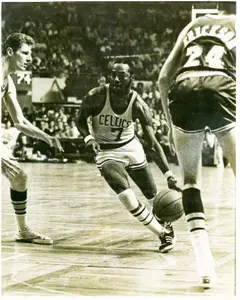
The Celtics had won nine of 10 NBA titles when Bryant joined them for the 1968-69 season. This would be the last season for player-coach Bill Russell and Sam Jones, and K.C. Jones had just retired. John Havlicek, Don Nelson, Satch Sanders and Bailey Howell were back to defend the title. Team president Red Auerbach had seen Bryant playing at a resort in the Catskills in a benefit game for Maurice Stokes.
"The new expansion team in Phoenix had purchased my rights from the Knicks in 1968," Bryant said. "I told general manager Jerry Colangelo I didn't want to live in Phoenix and would retire. Red contacted me and said if he made a deal, would I play for Boston. I jumped at the chance.
"We backed into the playoffs as the No. 4 seed when Cincinnati lost on the last day of the season. We faced the 76ers in the conference semifinals and won that series 4-1. We beat the Knicks in the conference finals 4-2 and then defeated the Los Angeles Lakers in seven games for the NBA title. We did not have home-court advantage in any series."
Bryant played a pivotal role in games four and five. The Celtics were down 2-1 in the series and trailed late when Bryant's steal with 15 seconds left led to Sam Jones' game-winning shot 12 seconds later in the 89-88 win.
The Lakers took game five 117-104 but not without suffering the biggest injury of the series. Bryant had stolen the ball from Jerry West in the fourth quarter and when West lunged for the ball, he sustained a hamstring injury that had him limping through a game six loss in Boston.
In game seven, the aging Celtics overcame the LA superstar trio of West, Wilt Chamberlain and Elgin Baylor to squeeze out a 108-106 victory. Lakers owner Jack Kent Cooke had thousands of balloons proclaiming "World Champion Lakers" in a giant net suspended from the Forum rafters. During pregame warm-ups, Russell told West: "Those bleepin' balloons are staying up there."
West had a memorable game with 42 points, 13 rebounds and 12 assists, but Havlicek finished with 26 points, Jones 24 and Bryant 20. It was Russell's final NBA title and culminated the end of an era.
When Bryant arrived in Los Angeles for the championship opener, he received a telegram asking him to call a Mr. Hunter. It turns out this was the same park district instructor who had kept a watchful eye on a young Bryant while allowing him to stay late and play against the older players.
"He taught me how to play ball, and now he was living in LA," Bryant said. "He had my tickets for all four games at the Forum because he was like my family. When we won it all, I brought him on the floor. We embraced and both started crying. Neither of us knew what life had in store for us. I was a 10-year-old kid hanging out in a gym and he looked out for me."
Bryant was double-promoted in grade school and entered McKinley High School at the age of 12. He ran into problems and was sent to Montefiore Academy which specializes in students with behavior or emotional issues. From there, Bryant wound up at a state reform school in St. Charles where his physical education instructor was eventual Illinois Secretary of State Jesse White.
"He was my gym teacher and basketball coach," Bryant said. "He was All-City in baseball and basketball at Waller High School (Lincoln Park), starred in both sports at Alabama State and played in the Cubs minor league system.
"We used to have intramural basketball with cottage against cottage. The best players were selected for the all-school team and outside teams from Boys Clubs and organizations like that would come in and play us.
"He told me I should be playing somewhere else and that I was wasting my time at St. Charles. Everybody told you that, and I thought it was just another voice in the wilderness."
Bryant enlisted in the Air Force and became a skilled radar operator stationed in Panama. He starred on the base team that played in a military conference against teams from the Army and Navy and led his team to several championships. After one game, a serviceman who wound up playing football for the Baltimore Colts told him he was good enough to become a college basketball star.
"I took the GED test just to see if I could pass it," Bryant said. "When I passed, I began to seriously consider offers to play ball and go to college. I liked Seattle University after reading about Elgin Baylor leading them to the NCAA title game. I considered an offer from Michigan State because I Iiked `Jumpin' Johnny Green.
"When I got out of the service, the Seattle U. coach was now coaching in the ABA. I went to Michigan State but coach Forddy Anderson was working clinics in Europe and no one knew about the arrangement we had discussed."
A disappointed 21-year-old Bryant returned home to the West Side and successfully tried out for an all-star team that barnstormed through the Midwest with the New York Harlem Satellites, an offshoot of the Harlem Globetrotters. A year later, he enrolled at Crane Junior College (Malcolm X) where he led the nation in scoring averaging 36 points a game.
"My coach at Crane was Paul Mall, who had been an assistant coach at DePaul," Bryant said. "He would bring us to have scrimmages against DePaul's freshman team. Coach Meyer liked the way I played and that was the start of a wonderful relationship with DePaul."
After his career was over, Bryant worked for the National Basketball Retired Players Association and is currently the vice-president of the Chicago chapter. Through various service programs, he is helping NBA players transition into life after basketball. He still plays ball at the age of 77, competing in a 70-and-over league.
"My days at DePaul came along at a critical time in my life," Bryant said. "I'll always be thankful for the opportunity to play ball for coach Meyer and for everything I learned while going to college."