DePaul University Athletics
Cahnman Grateful for DePaul Turning His Life Around
2/26/2015 12:00:00 AM | MEN'S TENNIS
(Fourth in a series of feature stories portraying the Class of 2015 honorees being inducted Saturday into the DePaul Athletic Hall of Fame)
CHICAGO – As Ray Cahnman begins walking up to the podium on Saturday night at the DePaul Athletic Hall of Fame induction ceremony, what the audience at McGrath-Phillips Arena will see is the protagonist of a true American story that speaks to what this magnificent country is all about.
Cahnman is just what author Horatio Alger envisioned in his novels about boys rising up from humble backgrounds and overcoming adversity in a rags-to-riches narrative.
Once the late DePaul Hall of Fame coach Jim Seri gave Cahnman a tennis scholarship back in 1966, there was no stopping this tenacious young man from the South Side who spent some time working the midnight shift at a South Side steel mill.
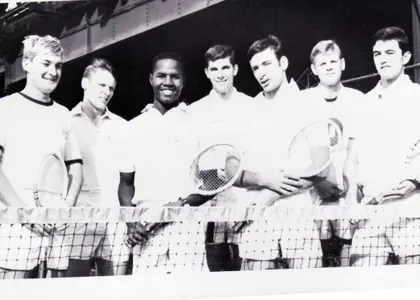
The essence of what DePaul is all about was right there in the 1967 men’s tennis team that was inducted into the school’s Hall of Fame five years ago. Most of the student-athletes came from families that could not afford to pay for a college education. Some were the first in their families to attend college.
“That’s DePaul’s mission and we were living, breathing testaments to that ideal,” said Cahnman, who compiled an eye-opening .880 winning percentage which was the highest of any Blue Demon from 1959 to 1967. “Something connected at DePaul that allowed our team members to persevere through adversity and become highly successful.”
The Blue Demons finished that 1967 season with a 22-3 record and qualified for the NCAA Division II National Championship where the team battled to a fifth-place finish. Long Beach State won it, and teams from Texas, Florida, California and the East Coast were represented.
Cahnman’s teammates included Terry Garvey, George Hahn, Allen Kiel, Nate King, Mel Searles and Steve Williams. In addition to the NCAA appearance, DePaul also claimed the Chicagoland Championship.
Led by Seri, a truly insightful and innovative tennis coach, these Blue Demons overcame all kinds of obstacles. During the offseason, they practiced on a handball court with Seri taping up targets for his players to hit. They also practiced in an old, abandoned theatre, taping down lines on the wooden floor. During one practice, Williams hit a lob shot that struck a large, overhanging chandelier and brought it crashing to the floor.
Kiel nicknamed this team “The Lost Boys” since most of the players were local kids from poor families searching for their lot in life. The scholarships Seri divided up among the team members were their saving grace.
Cahnman made the biggest turnaround. Academic issues forced him to transfer from Illinois, and he made the most of his second chance.
“We were all city kids who didn’t come from much money,” Cahnman said. “I was scraping the bottom, and when coach Seri gave me that scholarship, it turned my life around. What I learned from playing tennis and going to school at DePaul allowed me to make it in life.”
Cahnman is being inducted along with along with women’s basketball star Kim Williams, women’s softball standout Eric Hickey Dransfeldt, men’s basketball star Quentin Richardson and the 1999 Women’s College World Series softball team.
The formal induction ceremony and banquet takes place at 6:30 p.m. Saturday at McGrath-Phillips Arena.
The Class of 2015 will be honored at halftime of the 1 p.m. men's basketball game Saturday against Butler at Allstate Arena and at halftime of the women's basketball game Sunday against Marquette that tips off at 3 p.m. at McGrath-Phillips Arena.
For information on ordering tickets to the Hall of Fame ceremony and banquet, please contact Katie Ramsey at cramsey1@depaul.edu or (773) 325-7504.
Cahnman graduated from DePaul in 1967 and maintained his competitive edge in tennis. He was ranked in the top five of the men's open singles division by the Chicago District Tennis Association from 1969-75, finishing with the No. 1 ranking in 1975. Six years later, he was the top-ranked player in the 35-and-over division.
Cahnman began his immensely successful career at the Chicago Board Of Trade in September, 1975 as one of 19 original interest-rate futures market makers. He actively traded for the next 39 years, first as an open-outcry pit trader and then successfully transitioning into a screen-based trader.
In 2000 he was elected to the board of directors at the Chicago Board of Trade for a three-year term. This defensive-minded, bulldog of a tennis player has amassed an immense fortune as a trader by utilizing the same traits that made him a winner on the court.
In 1980, he founded Transmarket Group LLC. He is chairman of the board of a company that trades thousands of futures contracts every day on multiple exchanges across the globe.
“When I was working at the Chicago Board of Trade, I made good use of all the athletic competitiveness from college tennis and was able to really focus on the task at hand,” Cahnman said. “It set me apart from the average guy down there, and I was able to take advantage of it for a long time.
“I am so proud that I am a DePaul graduate. The two years that I spent here gave me the foundation necessary to survive for almost 40 years in a cut-throat business.
“In the classroom, I learned from great professors. On the tennis court, coach Seri taught me how to compete and most important, how to overcome adversity. Being able to sometimes prevail against superior talent gave me the ability to believe in myself.”
There was never an edge the resourceful Cahnman failed to exploit to his advantage.
“I loved playing on the old tennis courts where the Sullivan Athletic Center now stands---especially the one closest to the ‘El’ tracks,” Cahnman said. “The noise and the wind generated by the El train would freak out opponents, and I needed all the edge I could get. I liked to practice on a court bordering Sheffield. My hope was that a cute coed would stop and notice my game.”
That was a DePaul from a bygone era when tuition was $1,000 a year and the Lincoln Park campus consisted of Alumni Hall and two buildings at Belden and Kenmore. There were no dorms, and only the basketball players lived on campus.
“DePaul was 100 percent a commuter school,” Cahnman said. “Most students held part-time jobs in order to pay tuition, and I was no different---except I had the best job. My job was to whack a tennis ball which is what I loved to do.
“I had a tuition waiver, free books and a priority registration for any class. We were given DePaul warm-up sweats and we cracked open new balls when we practiced. I felt like I won the lottery.”
Cahnman’s connection with DePaul goes back nearly 50 years to a time when the school had to support a minimum of two other sports to remain in Division I basketball. Track and tennis were deemed the most economical choices.
“For track, they awarded a few scholarships and had the runners train in Lincoln Park,” Cahnman said. “Tennis was even easier. Before the Athletic Center was built, there were 11 tennis courts in that location. For the cost of three full and three half-scholarships, DePaul fulfilled its requirement.
“Coach Seri's recruiting budget was limited to a telephone line with local calls only. Ray Meyer's budget was not much better, and his star recruit was his son Tommy.
“Meyer was a great coach, teacher and mentor. He was somehow able to take overlooked high school players that no one wanted and turn them into star Division I players. He had a special talent for working with awkward, big men and developing them into graceful centers.
“Years later he was able to get commitments from some of the most heavily recruited players in the state and across the country. That culminated in an Elite Eight finish in 1978 and a Final Four appearance in 1979.”
There is a distinct parallel in the way both Cahnman and DePaul have come such a long way from humble beginnings.
“DePaul is a multi-million dollar educational institution, and the head of it all is Father Dennis Holtschneider,” Cahnman said. “What he has accomplished in building this university to what it is today is truly remarkable. He is the best university president in the country.
“The Lincoln Park campus now extends from Lakewood to Halsted. It seems like every year a new building is added. The downtown campus has quadrupled in size---and how about the new basketball arena being built near McCormick Place? Every top school in the country is going to want to play there, and our ballplayers will be competitive with the best.
“DePaul is the biggest and the best urban Catholic university in the country. Students apply internationally and from every state in the country. It's not easy to gain admission with academic standards being so high.
"In Chicago, more teachers, lawyers and accountants have diplomas from DePaul than from any other school. It was true 50 years ago and is still true today.”
More than ever, Cahnman remains among the staunchest supporters of the university, its athletic department and the tennis program.
“I walked away from DePaul knowing that with hard work and a strong focus, much could be accomplished,” Cahnman said. “Over the last 45 years, I was able to successfully apply my DePaul experience into my career as a futures trader.
“Unlike Saturday night’s other honorees, no one ever bought a ticket to see me play. DePaul never asked for any repayment for what I was given. I feel an obligation to continue to financially support this great institution that put me on a path to success.
“Almost 50 years ago when coach Seri offered me a partial scholarship, I promised myself that if I ever could afford it, I would return the favor.
“Thank-you, DePaul.”
(Friday: The 1999 Women’s College World Series Softball Team)